A USEFUL WARTIME KIT PROTECTS CARE, INFORMATION AND SAFE DECISIONS.
What belongs in a World War III emergency kit that wouldn't already belong in an ordinary household emergency box? Surprisingly little specialist hardware. The crucial differences are the circumstances in which the kit may be used: prolonged interruption of services, separated family members, possible restrictions on travel, damaged buildings and the need to act on verified local safety instructions. A heavy military-style backpack does not solve those problems by itself.
This guide builds a civilian wartime emergency kit around the practical jobs a household may need to do—maintain essential care, receive information, remain safely indoors where appropriate, and leave without unnecessary delay if instructed. For realistic water and meal quantities see the 72-hour home kit guide; here we focus on what changes in a conflict scenario and how to prove each item is useful.
Begin with three different needs, not one universal bag
Keep a home-reserve module for bulky drinking water, normal foods and basic sanitation, an immediate-use module for light, radio, phone power and contacts, and a portable departure module for medicines, documents and an actual safe journey. The modules can be stored together if space permits, but the water for several people cannot sensibly all go in one rucksack.
| Need | Useful capability | What needs verifying |
|---|---|---|
| Stay safely during an external hazard | Appropriate shelter location, essential medicines, safe water, independent information | Building suitability, current instructions and dependent care needs |
| Short service outage | Battery light, usable charger, radio, ordinary food and hygiene | Actual batteries, safe cooking requirements, accessible items |
| Separated household | Paper contacts, agreed check-ins, trusted relay, school/carer instructions | Correct numbers and the people able to follow the plan |
| Directed evacuation | Manageable bag, identity and care information, weather layer, known destination | Safe route, transport, accessibility, authority instructions |
| Radiation emergency | Ability to remain in the most suitable available building area and receive official advice | Hazard-specific instructions; ordinary supplies are not radiation shields |
The British Red Cross household preparedness advice supports planning from real people, medicines, contacts and essential supplies. It does not require a warehouse of survival products.
The first item is an accurate plan
Write the local emergency number, building fire or evacuation instructions, the safe location for ordinary sheltering, a verified public information source and a trusted relay contact. Include a note explaining where any medically critical care plan is kept. Review the numbers when providers, schools or household members change.
A practical kit without a decision rule can cause mistakes. Somebody may try to drive towards a distant relative during dangerous fallout rather than shelter in the nearest suitable building. The UK radiation-emergency guidance says to go indoors, remain and follow local instructions rather than travel home through an affected area. For a fire in the home, immediate escape can be necessary instead. The hazard—not the kit—determines the action.
Our one-page household plan provides the action-card format, while the family check-in sheet handles people and messages.
Water: useful at home, awkward to carry
A common UK household starting figure for drinking water is around 2.5–3 litres per person per day. Three people planning for three days at 3 litres require 27 litres, about 27kg before containers. That is a home storage quantity, not a reasonable suggestion that everyone should walk around carrying a three-day water supply.
Keep known-safe water in suitable sealed food-safe containers, stored where the household can reach them. A suspect outside source is not automatically safe after boiling: boiling addresses some microbial hazards, not radioactive substances, industrial chemicals or dissolved contaminants. During a declared radiation incident, follow the specific public-health instructions about drinking water and food.
The UK guidance distinguishes the need for safe sources from unnecessary journeys. Bottled drinks or food already sealed and protected indoors are useful; there is no reason to leave a protected shelter to collect another drink if outdoor exposure is hazardous.
Food: aim for safe meals when cooking cannot be relied upon
Use familiar shelf-stable foods with an actual meal plan. A ready-to-eat tin, shelf-stable drink, fruit and suitable staple can make a workable meal, while dry rice still requires an appropriate safe cooking method. Check allergens, serving sizes and packaging instructions, especially for children and anybody with medical dietary restrictions.
For three people eating three daily meals over three days, count 27 person-meals, but remember that one tin isn't necessarily a complete meal. Keep a manual opener if necessary. Avoid assuming opened leftovers can be held safely without refrigeration.
For detailed meal construction use the three-day food plan or balanced shelf-stable meals. The wartime distinction is continuity and flexibility: if a familiar product is delayed, you should know an appropriate substitute rather than have to shop at the last minute.
Medication and individual care outrank tactical gear
List prescribed medication, provider numbers, relevant mobility equipment, glasses, hearing supplies and any specialist dietary or medical needs. Discuss contingency supplies and power requirements with the appropriate pharmacist, clinician or equipment provider. Never alter medicine doses because you fear that a future conflict might interrupt deliveries.
People needing dialysis, oxygen, refrigerated medicine or powered care equipment require a specific authorised arrangement; a large power bank bought on impulse may not be compatible. Keep a short private care summary where authorised helpers can retrieve it, without exposing sensitive details to visitors.
For prescription shortages or an unexpected delay, the NHS emergency prescription guidance explains the normal support channels. Widespread service disruptions may affect access, so clarify necessary contingency procedures before an incident when possible.
Lighting, charging and independent information
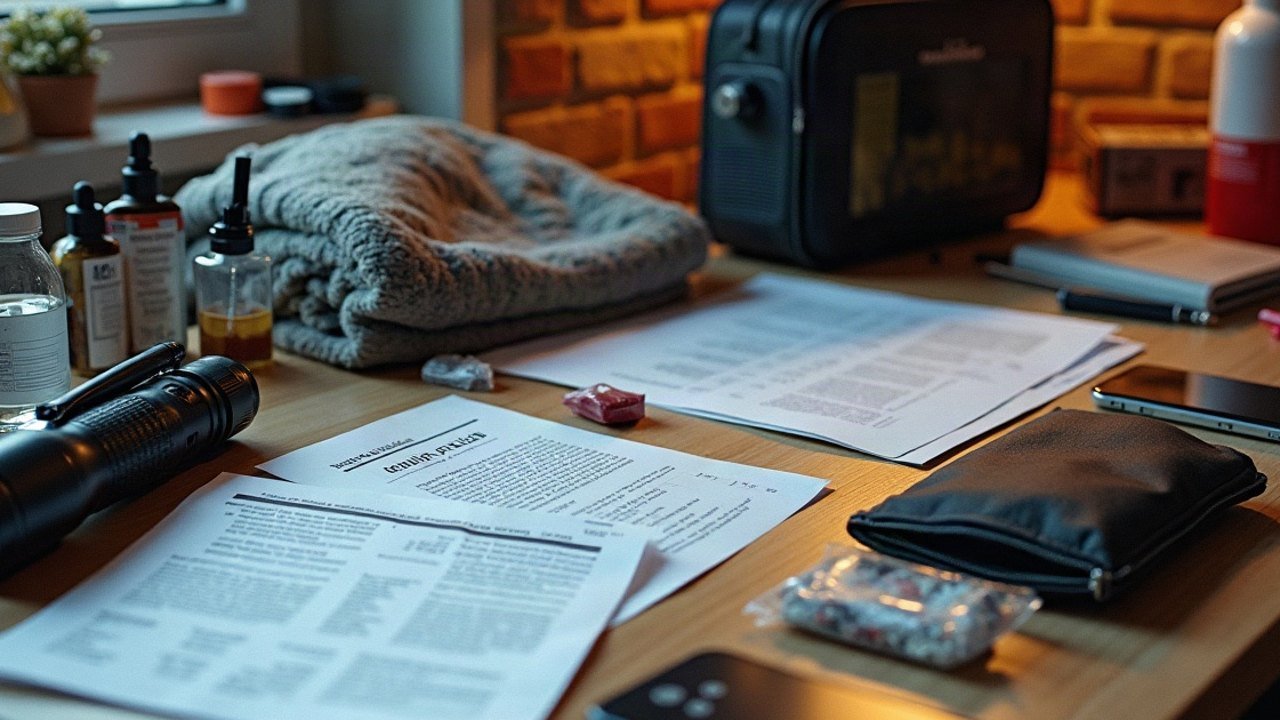
Pack a working LED torch, a suitable backup light, the intended cables and a power bank tested with the actual phone. A battery-powered FM/DAB receiver can provide a separate information channel if home broadband fails. Check reception in your own building rather than relying on a product label.
For UK residents, Emergency Alerts may provide certain location-specific life-threatening warnings, but not every hazard or war-related announcement produces a phone alert. Check current official news and local public safety instructions through more than one medium.
A programmable radio is not an automatic legal nationwide telephone system. If you need nearby two-way contact, see the UK PMR446 rules; for other off-grid options, see the communication comparison. An emergency kit should include a communication method only when the intended recipient can realistically use it.
Radiation-related items: what helps and what doesn't
For an actual radioactive fallout incident, the most consequential protections are time, suitable shelter, distance and verified instructions. A consumer dust mask may reduce inhalation of some particles during limited necessary movement, but it does not block external gamma radiation. A foil blanket, ordinary coat or Faraday bag is not a radiation-proof shelter.
A simple clean clothing change, closable bag for potentially contaminated outer garments, soap, clean cloth and washing access may help with decontamination if relevant. The UK self-decontamination guidance explains that carefully removing outer clothes can remove much of deposited contamination and gives a washing procedure.
Do not take potassium iodide as a general war supplement: the CDC explains it protects only against radioactive iodine entering the thyroid when appropriate, not blast, external radiation or all fallout materials. Take it only as instructed by relevant public-health or clinical authorities.
Don't make sheltering dependent on a car journey
In a radiological emergency, a car offers little shielding compared with a suitable substantial building. The CDC radiation guidance prioritises getting inside quickly, preferably towards a basement or the interior of a brick or concrete building, then following instructions. The right location also depends on fire, flooding, structural damage and accessibility.
Keep a small set of essentials available in the part of the building that would ordinarily be practical to shelter in, if appropriate. Do not block escape routes or build an unauthorised sealed room. Safe, breathable air and access for people with disabilities remain vital.
The next two articles explain fallout protective actions and what shelter construction can realistically do, including limits that a product list cannot resolve.
The departure bag is deliberately smaller than the home reserve
A civilian departure bag may include protected documents, medication and instructions, weather clothing, suitable food and water for the intended journey, a light, phone power, keys and the family contact sheet. The weight needs testing by the person who will actually carry it while assisting children or someone with mobility needs.
Do not assume a local shelter accepts animals, that public transport is running or that a border can be crossed simply because it looks open on an outdated map. Agree realistic destinations and avoid unverified safe-passage claims. The UNHCR guidance on humanitarian evacuations treats verified routes, destinations and family unity as essential.
Use the bag weight test and the evacuation route plan for the mechanics; they should not be duplicated in full in an article about war-related kit priorities.
A practical six-part equipment test
| Function | Simple safe test | Failure that matters |
|---|---|---|
| Light | Turn on the torch and locate replacement batteries | No usable light in the intended storage area |
| Phone power | Connect the exact phone and cable to the power bank | Wrong plug or depleted bank |
| Information | Receive a real local station on battery power | Receiver depends on the missing mains or signal |
| Documents | Retrieve a current contact without internet | Everything is locked behind a cloud login |
| Food | Prepare a normal safe ready-to-eat meal | Needs a cooker, opener or refrigeration unavailable in the scenario |
| Departure | Carry the full realistic bag on a safe ordinary route | Too heavy or cannot be handled while assisting a dependant |
Don't test by switching off critical medical devices, triggering an emergency alarm or driving towards a protected site.
Budget order: close the serious gaps first
Start by checking what you own. A household with working torches, ordinary food, suitable clothes and secure identity copies may only need to organise the location of supplies and resolve an important medical-care or contact gap. A branded “wartime” pack may duplicate everything while omitting a necessary personal item.
Rank the gaps by consequence, practicality and cost. Our buying-priority guide includes a worked small-budget method. Avoid storing large sums of cash or expensive electronics where theft, flood or fire could take everything at once.
Frequently asked questions
Do I need a special military survival kit for World War III?
No universal kit is suitable for every conflict. Essential civilian functions—care, safe water, usable food, information, documents and realistic departure arrangements—should determine the contents.
Should the whole 72-hour supply fit in a backpack?
No. Bulky water and food can be stored safely at home; a portable bag should meet the actual journey and carrier's ability.
Does a respirator or iodine tablet protect against nuclear fallout?
A suitable respirator may reduce inhaled particles in specific circumstances but not external radiation. Potassium iodide protects only against specific radioactive iodine exposure when public-health authorities advise it.
How often should I check a wartime emergency kit?
Review when household care, medicines, contacts or circumstances change, and check consumables, battery performance and document access on a schedule you can maintain.