A GOOD HOUSEHOLD PLAN TELLS EVERYONE WHAT MATTERS FIRST AND WHAT WOULD CHANGE THE NEXT DECISION.
When the lights go out, do you know who needs help first, which supplies are actually ready and what would make staying home unsafe? A household can own excellent emergency equipment yet fail to agree on those decisions. A one-page plan turns scattered preparation into a short set of actions everyone can locate and understand.
Use this guide to build a household emergency plan covering immediate safety, essential dependencies, family roles, contacts, staying or leaving, and the trigger for reconsidering the decision. The companion printable one-page worksheet has blank fields to fill in by hand—no registration, account or private data submission.
This is a different tool from the family contacts and check-in sheet, which concentrates on people and messaging. The household plan is an action card: what do we check, what do we do next, and when should we change course?
Design around the first decision, not around every disaster
Most people will not read a twenty-page manual during a sudden interruption. Put the first safe actions at the top and keep supporting documents in a separate folder. The British Red Cross October 2026 guidance recommends knowing where essential supplies are, how to stay in contact, how to receive updates and what the household would do if it needed to leave.
On a single page, provide enough information to find the relevant items and people. Don't include whole insurance contracts, every potential scenario or pages of hypothetical warnings. Those belong in the offline information folder if they are necessary.
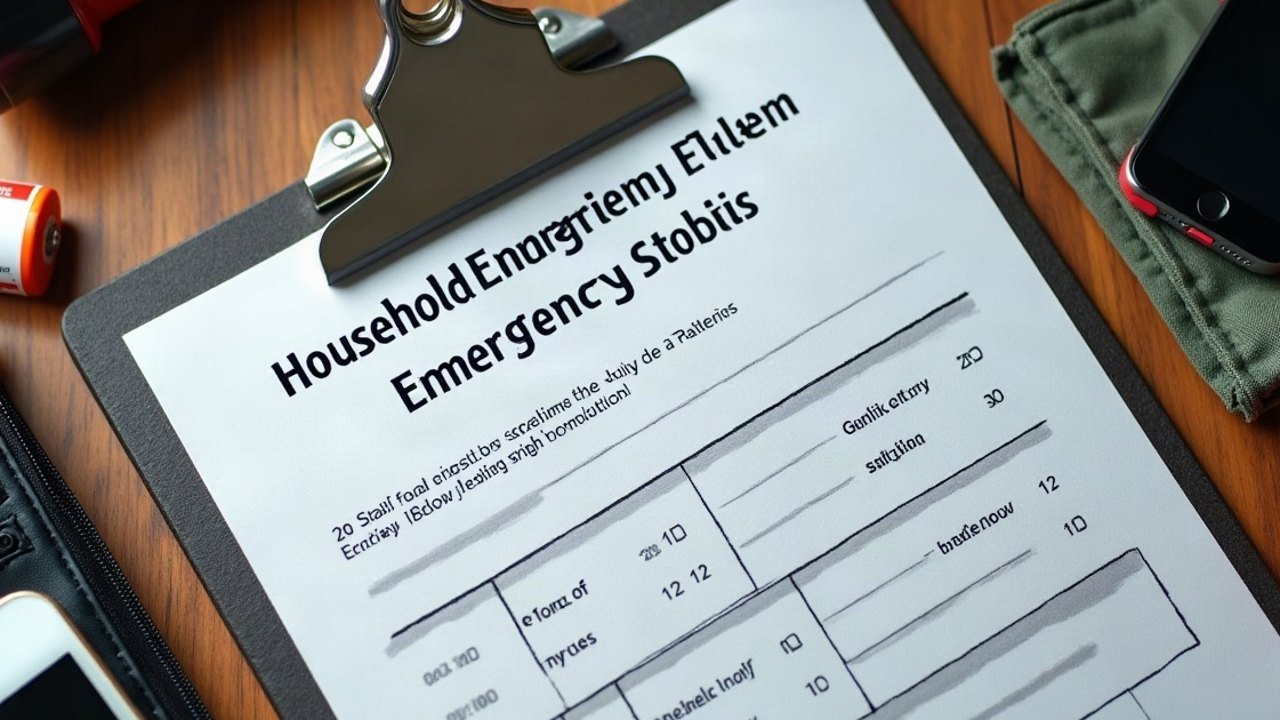
| One-page field | Question it answers | Good entry |
|---|---|---|
| Immediate safety | What takes priority if someone is in danger? | Location of exits, emergency services and building-specific instructions |
| People and care | Who may need help or equipment? | Named responsibility and where protected care details are kept |
| Essential supplies | Where are water, medicine, light and contact information? | Actual accessible storage locations |
| Stay/leave decision | What would change our action? | Verified warnings, direct instructions and inability to meet essential needs |
| Contact and reunion | How will people confirm safety? | Trusted relay, basic check-in rule, reference to contact sheet |
| Review | Can we trust this copy? | Most recent review date and responsible adult |
Field 1: write the safety rule in plain language
Place emergency information at the top. In the UK, 999 and 112 are the emergency numbers for immediate danger; the correct responder and information depend on the event. The general instruction should not ask people to evaluate an entire risk chart before leaving a fire.
For a house fire, safe escape and a call from outside take priority. For a flat, use the building's current fire strategy and instructions. For a flood, avoid entering floodwater and follow warnings and official evacuation directions. Those differences matter more than a decorative “emergency level” score.
The London Fire Brigade warns that building evacuation strategies differ. An ordinary household action card should therefore record where the actual instructions are found rather than invent a universal rule for flats.
Field 2: name who needs help and who does what
A useful entry is specific: “Adult A checks on the person needing mobility help; Adult B collects the protected medical information if safe.” A vague phrase such as “take care of children” leaves decisions to the person who happens to be closest to the door.
For people relying on powered medical equipment or refrigerated medicine, a one-page card should point to an individual approved contingency. Do not place unnecessary medical diagnoses or passwords on a sheet that may be seen by visitors. Keep detailed instructions securely accessible to authorised people.
If somebody is absent, who is the backup? If a child is at school, what is the authorised collection process? If a pet needs a carrier, who can handle it? The family go-bag system develops those responsibilities; here, record the names and locations, not the whole explanation.
Field 3: replace “have emergency supplies” with actual locations
The plan should state where immediate-use items are stored. Examples: “Torch and spare batteries: hallway drawer.” “Safe drinking water: lower utility cupboard.” “Paper contacts: labelled folder on kitchen shelf.” “Personal medicine continuity plan: protected file accessible to named carers.”
A list without locations is often useless when a different household member needs to act. Check that someone with limited mobility can reach the right item. Keep the location instructions current when you reorganise furniture or move supplies.
Use our 72-hour home-kit guide to calculate actual water and food quantities. Do not crowd those arithmetic tables onto the one-page action card.
Field 4: state your source of reliable updates
Write the normal official alert or local information channels appropriate to the property, plus a working alternative when broadband is unavailable. If relying on a radio, record a known station and check that the device can receive it on batteries.
Some hazards have location-specific services. In England, Environment Agency flood warnings indicate different conditions and possible actions; the exact warning for your property matters. Do not write “every flood alert means evacuate”.
Our radio guide and offline communication plan cover alternatives. Here, enter one or two actual channels the family has tested.
Field 5: define when the plan changes
A household might reasonably stay at home through an ordinary short power cut if it remains safe and essential needs are met. The decision changes if life-sustaining care cannot continue, indoor conditions become unsafe, sanitation collapses or emergency services direct evacuation. These are conditions to assess; the exact timing depends on the situation.
Write “Review immediately if…” followed by the few triggers that matter for the household. For example: “Emergency services direct departure”; “The house becomes unsafe”; “Critical medication or care cannot be maintained safely”; “The planned meeting place is inaccessible.”
The GOV.UK flood guidance makes clear that one should follow evacuation orders and not attempt movement through floodwater. A fixed meeting instruction must never override current safety directions. See the full evacuation plan for routes and fallbacks.
Field 6: give contacts and reunification a concise pointer
Use one trusted out-of-area contact or agreed relay where appropriate, plus the location of the fuller contact sheet. Record a safe meeting place and an alternative only after confirming they are realistic and accessible. A missed text is not automatically a signal to send everyone onto dangerous roads.
If children are supervised by schools or carers, ensure the adults' plan fits the institution's safeguarding procedures. If another adult looks after an older relative, agree that role beforehand. A concise action card should not create obligations for people who have not agreed to them.
The family check-in worksheet contains the contact table and message wording. Keep those details separate to avoid printing private numbers repeatedly on publicly visible household pages.
Example: a water outage while two people are away
Imagine a three-person household. One adult is at home, another at work, and a child is at school. Water stops flowing at the house. The action card directs the adult at home to identify the water supplier's current notice, assess whether drinking-water reserves are accessible and retrieve the household contact plan.
If the school is operating normally, the adult follows its authorised contact procedures rather than instructing the child to leave. If no public-health warning exists, the family still needs to distinguish loss of supply from water-quality problems. The plan points to the household water-outage guide for sanitation decisions.
The page does not need to predict how long the outage will last. It needs an owner for the next task, a source of verified information and a condition that would require a different action.
Example: a warning that might require leaving
Suppose a property receives a genuine local flood warning. The household checks the specific address and current official instructions. If there is time and a safe route, responsible adults confirm essential medicines, people, the departure bag and the chosen destination. If the warning escalates or emergency services instruct departure, the plan points to the evacuation procedure.
What if the normal road is already flooded? The action card does not instruct people to drive through it. It directs them to use a verified safe alternative or seek appropriate guidance and assistance. The full route map is in the protected offline folder; the one-page card lists only where to find it.
What not to put on the page
Leave off speculative predictions, numerical disaster probabilities, duplicate inventories, detailed medical histories, bank passwords and six pages of disclaimers. A one-page plan earns its place by reducing hesitation and clarifying decisions. Anything that does not change an action or help a person find the right information can be kept elsewhere or omitted.
If the plan grows longer each time you edit it, ask which detail should move to the supporting information folder. One-page does not mean every possible need fits into A4; it means the first actions do.
Use the printable action card
OPEN THE ONE-PAGE HOUSEHOLD EMERGENCY PLAN ↗
The companion sheet contains blank fields for immediate safety, essential people and supplies, information sources, the stay-or-leave decision, safe contacts and review date. Print it and fill it in privately by hand. It does not ask you to send personal details to the website.
If someone needs a large-print, accessible or translated version, adapt the layout to their actual needs; the goal is a usable plan, not a perfect-looking sheet. A responsible adult should check that every important instruction is understood.
A five-minute comprehension test
- Give the completed sheet to another responsible household member.
- Ask them to find the immediate safety instruction without prompting.
- Ask them to locate the first torch, drinking water and the contact folder.
- Give a harmless scenario and ask which official information source they would check.
- Ask what would cause the household to reconsider staying or leaving.
- Ask how someone at school, work or in care would be accounted for.
- Correct anything unclear and write the review date.
Don't practise by turning off critical medical equipment, blocking a fire exit or making fake calls to emergency services. A safe tabletop drill can reveal serious flaws without creating one.
Keep it current as the household changes
People move, numbers change, new medication is prescribed and routes become inaccessible. Review the sheet after any significant change and at a realistic regular interval. Replace obsolete paper copies rather than leaving several contradictory versions in drawers.
Some households need a trusted caregiver to keep an authorised duplicate; others need it in a private accessible location at home. Choose arrangements that protect personal information while ensuring the right person can find the plan when necessary.
Frequently asked questions
What should a one-page household emergency plan include?
Immediate safety actions, roles for essential people and care, locations of supplies, reliable information channels, conditions for staying or leaving, contacts, and a current review date.
Should the plan list every emergency supply?
No. It should state where essential supplies are kept. Detailed quantities, food rotations and equipment records belong in the home-kit checklist or offline folder.
Is this the same as an emergency contact sheet?
No. The contact sheet contains people, numbers and message arrangements. The household action card tells everyone what decisions and practical tasks come first.
Can I fill in the printable plan online?
The supplied sheet is intentionally blank and printable so sensitive household information can be entered privately by hand, without transmitting it to a website.