A RADIO ONLY HELPS IF YOU KNOW WHICH STATIONS IT CAN RECEIVE AND HOW TO POWER IT.
The internet is unavailable, your phone battery is getting low and a local storm has knocked out electricity. You switch on an emergency radio—but it receives only static. Is the radio faulty, are you using the wrong waveband, or has the broadcaster stopped transmitting? A radio can be a useful independent source of information, but owning one is only half the job. You need a receiver that covers the stations relevant to your area, a working way to power it and a basic understanding of what a broadcast can actually tell you.
This emergency radio guide explains FM, DAB, AM/MW and battery or wind-up power in the UK; how to choose and test a receiver; and the limits of radio during widespread disruption.
The UK guidance on power cuts recommends an independent battery or wind-up radio and writing down local frequencies. In June 2026 parliamentary evidence, senior BBC representatives explained the value of FM during emergencies while recommending access to both FM and DAB where possible. Those observations support a practical, tested receiver—not a guarantee that all broadcasts survive every disaster.
First: a broadcast radio is a receiver, not a walkie-talkie
A conventional FM, DAB or AM radio receives programmes transmitted by broadcasters. It can provide news, weather, road information and potentially verified emergency announcements. It cannot send your own distress message, ask a presenter to find a missing relative or call emergency services.
That distinction matters when comparing equipment. A battery broadcast set, a licence-free two-way handheld, a marine VHF radio and a satellite distress beacon are different technologies. Each has different frequencies, rules and capabilities. Buying a device labelled “emergency radio” does not make it able to communicate both ways.
For person-to-person planning, read how to communicate when the internet is down. For the legal UK use of local walkie-talkies, see our two-way-radio guide.
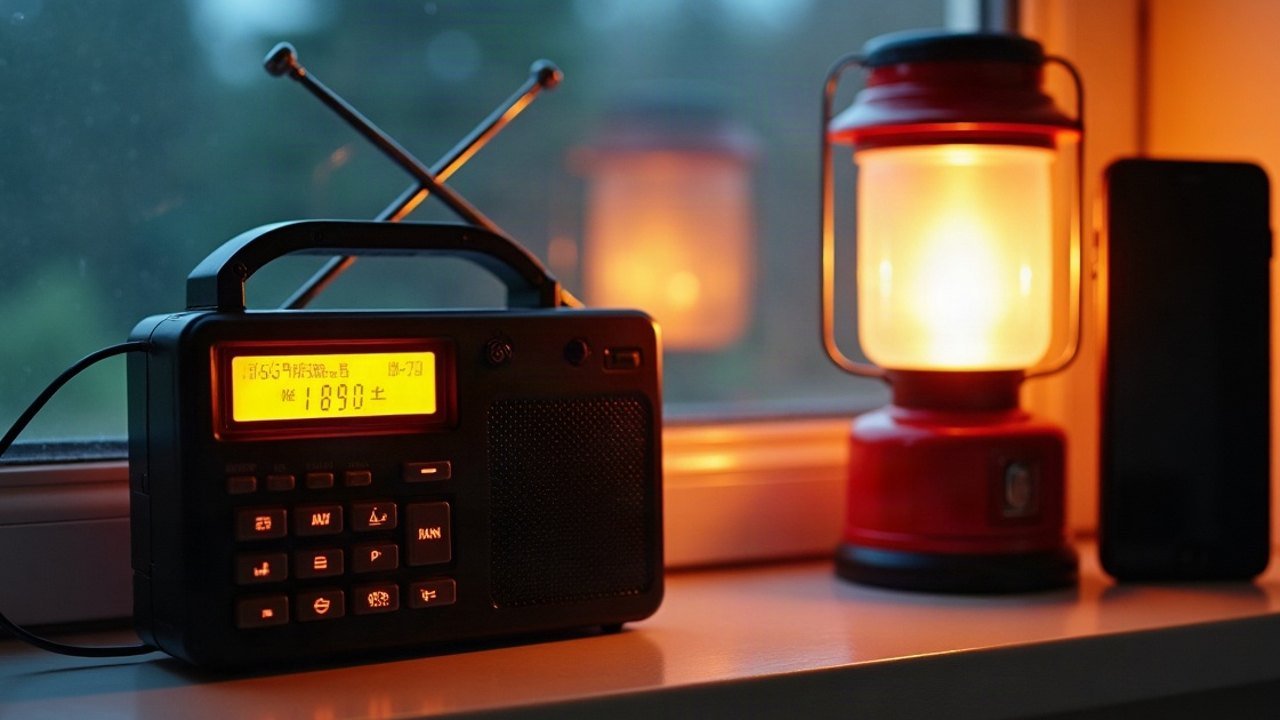
FM, DAB, AM and shortwave: what each is for
| Band or service | Likely UK use | Important limitation |
|---|---|---|
| FM broadcast | Local and national speech or music stations; familiar analogue tuning | Depends on station coverage, transmitter power and reception |
| DAB / DAB+ | Digital radio services, including many BBC and commercial stations | Requires a compatible digital receiver and adequate signal |
| AM / medium wave | Some remaining long-distance or specialist broadcasts, depending on the area | Service availability changes and electrical noise can harm reception |
| Shortwave | International broadcasts under suitable propagation conditions | Not automatically a reliable source of local UK emergency information |
| Internet radio | Streams through broadband or mobile data | Not independent if internet or router power is unavailable |
Do not assume that every UK station is transmitted on every band. A DAB-only unit cannot receive an FM-only broadcast. Conversely, an FM-only receiver will not decode digital DAB services. Check which stations are relevant to the places where you actually live or travel.
Why FM and DAB together are sensible
The BBC's oral evidence to a House of Lords committee on 25 June 2026 described FM as a resilient broadcast medium when backup transmitters are operating, while explaining that emergency information may be distributed across both FM and DAB and adapted to the event.
One especially useful point from that evidence was that the BBC would use the platforms available and could localise information over its existing services. There is no single published “magic emergency frequency” that every UK receiver should tune to in every incident. The correct stations depend on the region and what remains operational.
A practical receiver with usable FM and DAB coverage is therefore a reasonable option to evaluate. A device with ten exotic features but poor local reception is less useful than one that receives the relevant local station reliably.
What happens to radio transmitters during a power cut?
Broadcasting relies on powered studios, transmitters, communication links and distribution systems. Some infrastructure has backup power and contingency arrangements; some stations or components may fail. A battery radio lets you receive without mains electricity, but it does not supply electricity to the radio station.
That means you can have a fully charged receiver and still hear silence if the selected transmitter is unavailable. Try an alternative known station or waveband before concluding the receiver has broken. A broader incident might affect several broadcasters, so keep other information routes where possible.
For how communications networks depend on electricity, see our electricity-grid dependency map. A broadcast may remain on air even while mobile data is down, but neither outcome is guaranteed.
Battery, hand-crank, solar and USB power compared
| Power source | Strength | Practical constraint |
|---|---|---|
| Replaceable AA/AAA cells | Easy to inspect, swap and stock in compatible sizes | Running time varies; old cells can leak |
| Internal rechargeable battery | Convenient if regularly charged via a compatible source | Degrades with age; may be unusable when depleted |
| Hand-crank dynamo | Can provide small amounts of energy without a mains charger | Effort and output vary; many units have limited storage |
| Small integrated solar panel | May provide some charging in suitable sunlight | Variable and often limited by panel area, weather and angle |
| External USB input | Can use a compatible power bank | Requires an available, charged source and correct cable |
A device described as “solar/wind-up/USB” may still have an aging internal battery that limits its usefulness. Confirm whether the radio can operate directly from the crank or external supply and whether the maker specifies actual runtime at a given listening volume.
Why a wind-up radio is not a free unlimited generator
A hand-crank radio can be valuable when cells run low, but mechanical input and the battery's charging efficiency limit what it can provide. An instruction such as “one minute of winding gives ten minutes of listening” describes a manufacturer test condition, not a universal law. Volume, signal strength, battery condition and device design can change it.
Test the actual model while ordinary power is available. Wind it for a measured interval, listen to a known station and observe whether the power remains adequate. Avoid winding aggressively beyond the maker's instructions; a broken crank defeats the purpose.
If someone has limited hand strength, mobility or joint pain, a hand-crank may be less practical than a radio using replaceable common batteries. Accessibility matters more than an impressive emergency label.
Calculate likely battery use without inventing an exact runtime
For battery-powered receivers, basic energy arithmetic can help. If the manufacturer reports a typical 0.5W listening draw and a power source provides an illustrative 8Wh of usable energy, the energy-only estimate is 8Wh ÷ 0.5W = 16 hours. This is a hypothetical calculation, not a tested result for a specific radio.
Some digital radios draw more power than simple analogue sets; speaker volume, Bluetooth functions, display brightness and signal processing can change consumption. Your own device may have a different battery chemistry, protected reserve or voltage requirements.
Record how long the receiver actually operates at a useful listening volume rather than relying solely on theoretical capacity. For non-critical battery runtime calculations, our emergency power calculator demonstrates the same principle with measured loads and a reserve.
The important specifications before buying any radio
Check the broadcast bands, physical controls, tuning method, expected power source, audio output, headphone support, dimensions, waterproofing claim and actual documented consumption. If it uses replaceable batteries, verify their type and whether they are readily available. If rechargeable, check the cable, charging voltage and how the device behaves when the battery has deteriorated.
Look for an easily operated on/off switch, a readable station display or analogue frequency scale, and controls a person can use in the dark. A tiny multi-function radio with complicated menus may be poorly suited to someone with reduced vision or dexterity.
Don't assume that a built-in torch, siren or power-bank feature improves radio reception. Extra gadgets can add complexity and power demand. A plain, dependable receiver may be the better choice if you already own a good torch and phone charger.
Find two local stations and one national source today
Before any disruption, find stations relevant to the location where you expect to use the radio. Tune to them during ordinary broadcasting. Write down the station name, band, frequency if FM or MW, or digital service name if DAB, and whether the signal works indoors.
For example, an offline note might say “Local BBC station — FM [frequency observed on my set]; national BBC news — DAB [service name]; alternate local station — FM [frequency]”. Do not fill in the brackets from memory or assume a frequency used in another county applies to yours.
The UK power-cut advice specifically recommends writing down frequencies for local and national radio stations. A device that has never been tuned or tested is an incomplete household plan.
How to improve reception without unsafe improvisation
Try a different room, a position near a window, rotating the receiver and appropriately extending its built-in antenna. FM often benefits from antenna position; medium-wave sets may use internal directional antennas. Buildings, hills, electrical interference and nearby equipment all affect reception.
Stay indoors if a storm makes movement dangerous. Don't climb onto roofs, touch damaged cables or mount improvised aerials near power lines to improve a marginal signal. A small improvement in reception is not worth an electrical or fall hazard.
If a receiver works outdoors but not in the centre of a building, record that limitation in the plan. For somebody with mobility restrictions, choose a station and location they can access rather than expecting them to move equipment around in darkness.
Why imported 'weather alert radios' need checking
Some radios are marketed around the US NOAA Weather Radio service and its alert features. That specific service is designed for US geography and infrastructure; a UK resident should not assume the same alert system and frequencies exist locally.
For a UK household, focus on radio services actually broadcast in the area and verified UK alert sources. The UK's official mobile alert system is also distinct from a US-specific weather-radio alert. A device may still function as an ordinary FM receiver, but its NOAA-specific features can be irrelevant here.
Examine the product manual rather than trusting a seller who describes every siren button as a UK emergency broadcast decoder.
Radio versus phones, walkie-talkies and satellite devices
A phone is valuable for two-way contact while the required network works. A broadcast radio offers one-way information without needing internet. PMR446 handhelds provide limited two-way voice over a local distance. Satellite devices may offer messaging or distress functions under particular conditions and services.
None automatically substitutes for the others. A broadcast receiver cannot connect to 999, while a PMR446 handheld cannot summon an ambulance through a national dispatcher unless someone actually listening has an authorised route to call. Where a real emergency occurs, use a working appropriate emergency-calling method.
Our offline communications ladder integrates these different roles into one simple household plan.
Use a listening log rather than endlessly searching during a crisis
A radio may have interference or delayed information. Write down the station, time, exact wording of an important instruction and whether it was a verified broadcaster announcement or a caller's opinion. Compare the announcement with an official source if one remains accessible.
A scheduled check—for example, listening for several minutes at a known bulletin time if that station publishes one—can save batteries compared with leaving a receiver on continuously. But don't invent a schedule for a broadcaster or miss an urgent official warning in a developing incident. Use sensible judgement for the actual situation.
Note when the station last updated the information. A rebroadcast or repeated bulletin may be older than it sounds, and a social-media summary may distort it further. For distinguishing genuine warnings from imitations, see our emergency-alert verification guide.
Three useful reception tests
- Normal reception: tune the selected local and national stations inside the home and confirm intelligible audio.
- Power independence: run the receiver using only its intended battery or crank supply for a measured time, with no mains cable.
- Alternative band: if the model supports FM and DAB, test at least one working station on each and record the service.
You can do these tests safely without disrupting household services. Replace leaking batteries, damaged cables or unreliable receivers according to the manual. A cheap receiver you actually know how to operate may be a stronger option than expensive equipment left in its box.
Frequently asked questions
Should an emergency radio in the UK have FM or DAB?
Both can be useful. BBC representatives told Parliament in 2026 that FM offers resilience in some crises while emergency information may be localised over both FM and DAB. Check the actual stations in your area.
Will a wind-up radio always work without batteries?
Not necessarily. Many use a small internal rechargeable battery and have mechanical and energy limits. Check and test the specific device according to its manual.
Can a battery radio send an SOS or call 999?
An ordinary broadcast receiver cannot. It receives programmes. Sending messages requires another appropriate communications service or device.
Is a US NOAA emergency-weather radio suitable for the UK?
Its ordinary broadcast functions might work if compatible, but US NOAA-specific alerts and frequencies should not be assumed available in Britain. Choose a receiver for verified local UK services.