IF THE GRID FAILS, WHICH SERVICES IN YOUR HOUSEHOLD WOULD STOP NEXT?
A single street goes dark. Elsewhere the lights are on, but mobile payments stop working. A nearby block of flats has water-pressure problems and a supermarket closes its shutters. It is easy to describe all of these as 'the grid going down', but they may involve different parts of the electricity system and different secondary dependencies. Understanding the chain can help you distinguish a local fault from a wider disruption and decide which household services need attention.
This guide explains what happens when the power grid fails, from electricity generation through transmission and local distribution to the devices in your home. It also provides a practical dependency map you can adapt if you are concerned about a lengthy or cascading outage. It does not claim that a grid collapse is coming, and an electricity failure alone is not evidence of an AI-related attack.
Britain's National Energy System Operator (NESO) describes the electricity system as a series of interdependent organisations and assets, not one central switch. That distinction matters when a disruption affects more than one service.
How electricity reaches a household: five distinct links
Before discussing failures, trace the ordinary route. Electricity is generated at power stations or by renewable sources, moved on high-voltage transmission networks, stepped down and distributed locally before reaching a property. Commercial energy suppliers sell electricity and issue bills, but generally do not own the local cables that bring it to your door.
| Part of the system | Normal role | What an interruption could affect |
|---|---|---|
| Generation | Produces electrical energy from different sources | Supply available to the wider system, depending on replacement generation and reserve capacity |
| System operation | Balances supply and demand; coordinates system security | Frequency management, dispatch and restoration coordination |
| Transmission | Moves high-voltage power between regions and major connection points | Large connected areas if contingencies cannot isolate the problem |
| Distribution | Steps voltage down and supplies local networks and premises | Particular streets, towns or regions depending on the affected asset |
| Building installation | Meter, consumer unit, cabling and appliances inside a property | One home, one circuit or one item of equipment |
Ofgem explains the transmission-versus-distribution roles, while NESO clarifies that its transmission operation is distinct from the local distribution business. A failure in a house is not necessarily a grid failure, just as a generator stopping does not automatically mean every customer loses supply.
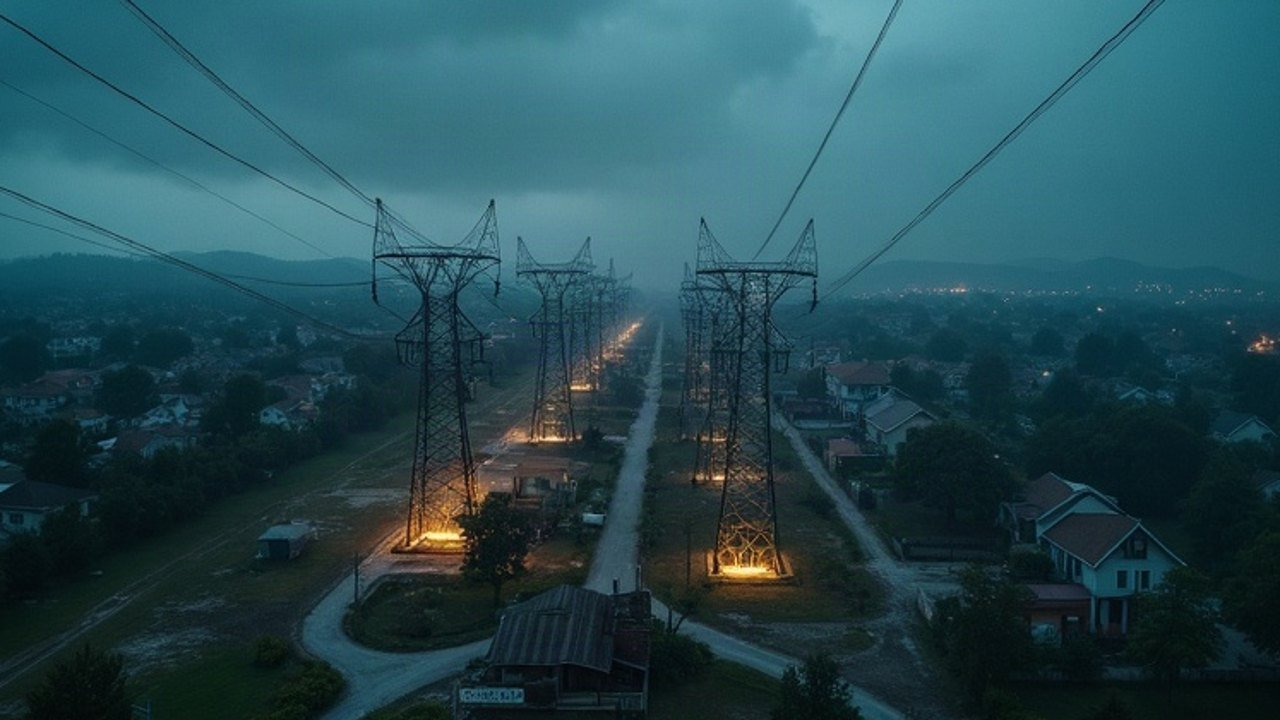
What is a cascading electricity failure?
A cascade is a sequence in which one disturbance affects other parts of the system. For example, losing a transmission line can shift power flows onto other lines. Protective systems may then isolate equipment to prevent damage, and further disconnections may follow if the network cannot accommodate the changed flows. A cascade can expand the area affected even if its initiating event was relatively small.
That is different from several unrelated local faults after a severe storm. When trees damage separate distribution lines, many neighbourhoods might lose power simultaneously without one failure spreading through the transmission network. It is also different from a deliberate, controlled disconnection intended to protect the wider system.
Technical reports following a major blackout examine sequences of equipment operations, voltage and frequency changes, protective relays, human decisions and restoration actions. A social-media claim that one 'hacked substation' shut down a country is not a substitute for such evidence. The mechanism and scale must be demonstrated, not guessed.
Why restoration can be uneven
Crews may restore one feeder while another remains disconnected for repair. Operators also need to confirm that lines and equipment are safe to energise. At a wider scale, generation and network conditions can require coordinated reconnection rather than switching everything back on at once. That means two adjacent streets can have different restoration times.
Ofgem's consumer power-cut guidance identifies local distribution network operators as the first contact for network faults in Great Britain. Under normal conditions, some categories of outage have regulatory restoration standards, but they are not guaranteed completion times for every event. Severe weather and exceptional conditions can change what is possible.
When an operator gives an estimate, record it alongside the time of the last update. Do not use an estimate to override a medical need or an increasingly unsafe indoor temperature. See our prolonged power-outage decision guide for the household choices that emerge over time.
Build a household dependency map from consequences
Your home does not receive electricity as an isolated service. Many other activities either use power directly or rely on organisations that do. Draw a map showing what stops immediately, what might continue for a while and what depends on backup power somewhere else.
| Household service | Direct electrical dependency | Secondary dependency to investigate |
|---|---|---|
| Lighting and sockets | Local electrical circuit | Safe battery lighting and charging |
| Gas central heating | Often electronic controls, ignition and pumps | Building temperature, clothing and safe alternative warmth |
| Broadband and digital phone | Router or optical terminal powered inside home | Provider network and street cabinet backup |
| Mobile communication | Phone battery | Mobile mast power, backhaul and network congestion |
| Running water | Sometimes electric building or well pumps | Water supplier pumping, treatment and pressure |
| Card payment | Shop terminals and network connectivity | Bank or processor systems and power at the merchant |
| Fuel, shopping and transport | Pumps, refrigeration, ticketing and signalling | Supply chains, staffing and local access |
| Medical or accessibility equipment | Device, charger or motor | Approved battery backup, care team and alternative premises |
Each row suggests a specific question. For a flat with electric water pumps, ask building management whether the pumps have backup power. For a digital home phone, ask the communications provider about battery arrangements. For a powered medical device, obtain an individual continuity plan from the clinical team and equipment supplier. Do not guess.
The first 10 minutes: identify what has actually failed
Begin with people and immediate hazards. If somebody depends on electricity for urgent medical support, follow their emergency arrangements and get help. Use a battery torch; avoid open flames. Check whether other properties are without power. Only inspect safe, accessible consumer-unit controls if you know how and the area is dry and undamaged.
If the outage extends beyond your property, check the known distribution operator's fault map or call 105 in England, Scotland and Wales. Northern Ireland has separate arrangements. Ofgem identifies 105 as the free route to the local electricity network operator. It is not an all-purpose emergency number and should not replace emergency services when life is at risk.
Do not assume that a failed mobile app means electricity has also failed at the provider, or that electricity outside means the internet is operating. Note distinct symptoms: no lights; working lights but no broadband; mobile data unavailable; water pressure low. This record is more useful than assigning an unverified cause.
What may happen to mobile networks and internet access?
A home Wi-Fi router normally stops when its plug loses power. Some internet equipment outside the home also depends on local electricity, although providers may have backup arrangements. A battery powering your router can be useful only if the wider network remains functioning and the battery is correctly sized and connected.
Mobile service may continue through backup power at nearby sites, or degrade because masts, backhaul and related infrastructure are affected. Congestion can make a working network difficult to use when many people call or refresh applications at once. A full battery and strong-looking signal icon do not guarantee messages will go through.
Keep essential telephone numbers on paper and identify local broadcast information sources. Our household cyber-disruption continuity guide covers alternative communication and account access when ordinary digital services fail, regardless of cause.
Could water and sanitation fail when electricity does?
Some mains water networks can supply homes without local electricity for a time; others use pumps, pressure systems and electrically operated treatment facilities. Upper floors and properties with private wells can be particularly dependent on pumping. A blackout does not by itself establish that water is contaminated, but supply and pressure may change.
Check verified water-provider communications if pressure drops, the tap stops or water looks unusual. Do not use a general 'boil everything' rule in place of the provider's instructions: boiling can reduce many microbial risks but does not remove chemical contamination. If a water authority issues a specific do-not-use order, follow it rather than improvising treatment.
Toilets may also be affected where waste systems depend on pumped equipment. Find out whether your building has such dependencies before trying repeated flushes. These decisions are covered in more depth by our planned water-service articles; this grid guide maps the relationship rather than repeating a complete water-treatment course.
When shops, cashpoints and fuel pumps stop
Card terminals depend on power and communications, and sometimes on remote financial services. Some shops may remain open using approved backup arrangements; others may close. Cash does not solve every payment problem if tills, lighting, refrigeration or store safety systems are unavailable. Likewise, a fuel pump may depend on electricity even when its storage tank has fuel.
Do not assume every bank or merchant shares the same failure. Verify what is working locally, use legitimate payment routes and avoid messages offering 'emergency account reactivation' links. Fraudsters can exploit uncertainty about outages. See our fake emergency alert verification guide if a forwarded warning asks you to pay, log in or move immediately.
For a household already without electricity, the more immediate priorities may be safe indoor temperature, food and medical support. Financial transactions can often wait while physical safety cannot.
How to distinguish a local power cut from a national blackout claim
The scale of an event cannot be inferred from one person's dark street. Check what the network operator reports, then corroborate wider claims with the system operator or independently established broadcasters. A verified regional outage is not equivalent to a national grid collapse. A widespread cloud-service problem can also mimic some effects of a blackout while the electrical network remains intact.
Three levels of evidence are useful: direct observation (your lights are off), official operational information (the distribution operator confirms an area fault), and independent technical investigation (the eventual cause and sequence). Keep these separate in any message you share with neighbours.
The same standard applies to possible AI involvement. AI-assisted cyber operations are an area of research and concern, but an outage by itself neither demonstrates autonomous AI control nor rules out future infrastructure risks. A careful article should not pretend to resolve an uncertain future by observing one present event.
A tabletop dependency exercise with three starting failures
You can create a meaningful plan without cutting any electricity. Take a piece of paper and imagine each of these scenarios separately. In each one, mark what you would actually lose and what remains independent.
- Local electricity fails for six hours: broadband router, refrigeration and central heating may stop. How do you receive an update and decide whether the home is still suitable?
- Electricity works but internet fails: lighting, heating and most sockets work. Which payments, communication methods and information sources still function?
- Several neighbourhood services fail together: electricity, local mobile data and a shop are affected. Where can you confirm the extent, and which household need becomes most urgent?
Compare the results. If all three scenarios rely on a single smartphone and cloud account, that is a dependency worth understanding. If essential equipment needs power, obtain a professionally tested and medically appropriate plan rather than assuming a generic portable battery will suffice. The purpose is to identify options, not simulate danger in real life.
What if an outage lasts much longer than expected?
As the hours pass, revise priorities. Refrigerated food safety may become a problem; indoor temperatures may change; phone batteries may decline; water systems may behave differently; and travel conditions may make an alternative location either safer or more dangerous. One universal '72-hour rule' is not a substitute for those conditions.
The British Red Cross's 2026 household disruption guidance considers multiple dependencies, including food, drinking water, communications and care needs. Our room-by-room week-without-electricity guide applies the same reasoning to longer periods without assuming that a prolonged failure is inevitable.
Why this is a dependency map, not a cause prediction
The electricity grid is a complex technical system, and secondary services have their own infrastructure and contingency arrangements. Some can fail together; others remain independent. Nobody can infer the likelihood, cause or future course of a crisis merely from the existence of dependencies.
If you are concerned about how future AI capabilities might interact with infrastructure, asking which services depend on which components and what evidence would establish a failure is more useful than pretending a blackout proves a theory. For a more focused discussion of AI-related infrastructure scenarios, see our AI infrastructure disruption guide.
Frequently asked questions
What happens if the national power grid fails?
Effects would depend on the parts of generation, transmission, distribution and related services affected. Some areas may retain power, while communications, heating, payments and other dependencies may be disrupted elsewhere. The scale and restoration sequence require verified operational information.
Does a local blackout mean the power grid collapsed?
No. A fault in a local distribution line, substation, property connection or building installation can cause an outage without a countrywide grid failure. Check your local operator's confirmed report.
Can mobile phones work during a grid failure?
Sometimes. Phone batteries may remain charged and some network sites may have backup power, but service depends on masts, backhaul and network conditions. An outage can affect those differently.
How can I tell if a power cut was a cyberattack?
You generally cannot establish that from household symptoms alone. Wait for evidence from credible technical investigators or responsible network operators. A dark street is not proof of an AI attack.