A WALKIE-TALKIE CAN CONNECT NEARBY PEOPLE—BUT ONLY IF THE EQUIPMENT AND ROUTE WORK.
A walkie-talkie box promises “up to 10km range”. You buy two, hand one to somebody across town and discover that they cannot hear you from the other side of a hill. What went wrong? The printed range is often measured under favourable conditions. Real performance depends on terrain, buildings, antenna design, legal power limits, batteries and whether both radios are set up to hear each other.
This is a UK two-way radio guide for emergencies, covering licence-free PMR446 equipment, realistic range, battery planning, channels, legal restrictions and a practical contact drill.
Ofcom describes PMR446 as a licence-exempt short-range personal and business radio service. Its business radio guidance distinguishes those permitted handhelds from transmitters that require an appropriate licence. The distinction matters more than online advertisements claiming that any powerful imported radio is “emergency legal”.
Start with a realistic role: local two-way voice
Two-way handheld radios are useful when two or more people need to exchange short messages and are within radio range. Example roles include family members in a large property, volunteers within a local site or a small group separated along a safe walking route. Both ends need functioning, compatible radios and an agreed operating method.
A radio cannot reach somebody who does not own a receiver operating on a compatible channel. It cannot automatically connect to an emergency call handler or mobile telephone network. A nearby group might be able to relay a message by another route, but that requires an actual person, permission and working communications.
For how these devices fit alongside phone calls, SMS, broadcast radio and paper check-ins, see our household offline communication plan. A broadcast emergency radio, described in our radio listening guide, provides incoming information rather than private two-way contact.
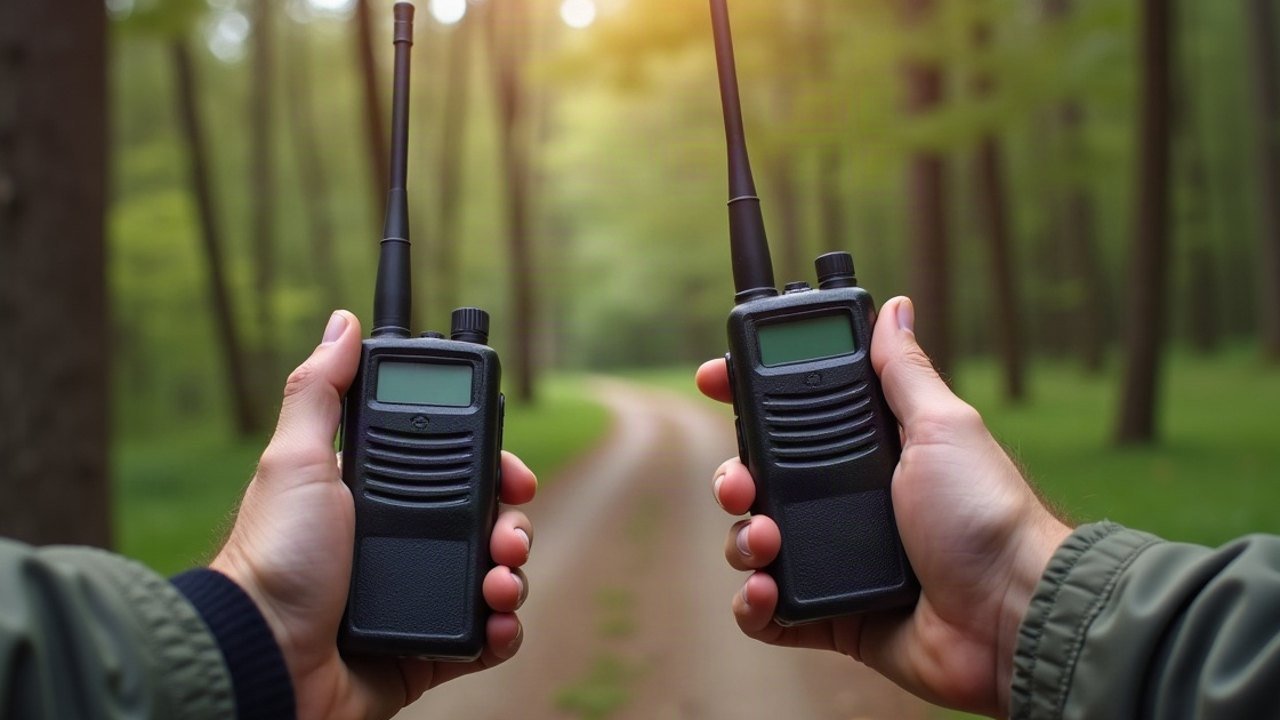
What PMR446 means in the UK
PMR446 is a licence-exempt short-range two-way radio system operating within the 446.0–446.2MHz band under specified technical rules. Compliant handheld equipment can be used without obtaining an individual radio licence for ordinary permitted communication.
Ofcom's analogue and digital PMR446 information sheet describes a maximum effective radiated power of 0.5 watt and short-range, handheld, peer-to-peer use. Ofcom's updated business guidance also specifies integrated antennas and excludes base stations, repeaters and fixed infrastructure under the PMR446 exemption.
Being able to select a 446MHz channel on an arbitrary programmable radio does not make that radio PMR446 compliant. The exact equipment, transmitting power and antenna requirements must be met. Check the manufacturer's regulatory conformity and the seller's UK specifications.
Licence-free PMR446 versus licensed radios
| System | Typical role | UK operating consideration |
|---|---|---|
| Compliant PMR446 handheld | Short-range personal or small-team voice | Licence-exempt within the technical restrictions |
| Licensed business radio | Organisational voice or specialist network | Requires an Ofcom licence appropriate to the system |
| Amateur radio | Licensed amateur communications and technical experimentation | Requires an amateur radio licence and compliance with its terms |
| Marine VHF | Marine communication and maritime distress | Subject to separate marine radio equipment and operator rules |
| Broadcast FM/DAB receiver | Listen to public information | Ordinary receiver; not a two-way voice system |
Do not treat all radios with removable antennas as legal unlicensed PMR446 devices. Some equipment can operate over many frequencies but needs an appropriate authorisation for transmission. The Ofcom radio-spectrum legal guidance explains the general licensing framework.
Why “up to 10km” is not a useful guaranteed range
Radio signals can be blocked, weakened or reflected by hills, reinforced concrete, dense buildings and other obstacles. A clear hilltop-to-hilltop path can perform much better than two people on opposite sides of a town. The walkie-talkie's antenna and the operator's body position also affect results.
A manufacturer's maximum distance may have been recorded under unusually favourable line-of-sight conditions. It is not a promise of coverage around a building, across a valley or between two vehicles. Effective radiated power is also legally limited on PMR446, so an advert promising extreme power may indicate that the device isn't compliant.
For planning, use the distance you have actually tested along the intended route, not the largest number printed on the box.
Line of sight: a practical way to think about coverage
Imagine two people with handsets. When they can see each other across an open field, their radio path has fewer obstacles. Put a wooded ridge between them, and even a shorter straight-line distance might fail. Move one person to an unobstructed safe open area, and coverage may improve. A building with thick walls can similarly reduce indoor range.
| Location pair | Typical challenge | What to test |
|---|---|---|
| Across an open field | Often fewer obstacles | Speech clarity and tested maximum reliable distance |
| Different floors of a large building | Walls, steel, reinforced concrete | Actual indoor room-by-room reception |
| Across a wooded valley | Terrain and vegetation | Whether the ridge blocks the path |
| Separate streets of a town | Buildings and street layout | Where a usable short-range link ends |
| Inside vehicles | Metal body and seating position | Whether both radios work at the intended locations |
Do not climb unsafe slopes, drive into floodwater or stand next to overhead cables to improve radio reception. An alternative safe meeting point may be more useful than an attempted signal test in hazardous conditions.
How to conduct a genuine range test
- Confirm both units are UK-compliant and have adequate batteries.
- Set both to the same compatible channel and signalling settings.
- Begin side by side and exchange clear test messages.
- Have one adult move along a safe, known route in measured stages.
- At each point, send a short voice message and ask the other person to repeat its key detail.
- Record the location and whether intelligible communication was reliable in both directions.
- Stop when it is no longer safe or useful; don't leave a child or vulnerable person alone for the exercise.
Repeating a test at different times can reveal interference or site-specific issues. Record the reliable operating area, not only the farthest place you heard a faint fragment once. A range figure is only useful when it reflects the environment in which the people actually intend to communicate.
Channels and privacy codes: they are not encryption
Two PMR446 radios must use compatible channel and transmission settings to hear each other. Some handsets label additional CTCSS or DCS tones as “privacy codes”. These tones generally tell a receiver when to open its speaker; they do not encrypt the spoken message or give exclusive ownership of a frequency.
Another compatible receiver on the same channel, especially one without the tone restriction, may hear the conversation. Others using the frequency may also experience interference. Avoid reading out sensitive personal or medical details over an ordinary walkie-talkie unless there is an appropriate reason and privacy plan.
Codes and channel numbering can differ between equipment models and analogue/digital systems. Read the manuals rather than assuming “channel 3” on every imported radio represents an identical configuration.
A simple voice procedure that reduces confusion
Before pressing the push-to-talk (PTT) button, decide what the other person needs to know. Wait for the channel to be clear. Press PTT, pause briefly so the beginning of your words isn't clipped, speak normally and release the button to listen.
For example: “House to Garden. Are you at the agreed gate? Over.” A reply might be: “Garden to House. At the gate now. Over.” If the listener needs a detail repeated, ask for the exact part instead of saying only “what?”. These are teaching examples, not an official emergency-services radio protocol.
Use plain language, short messages, consistent location names and explicit confirmation for an important instruction. If another group is using the same channel, wait appropriately or agree a permitted alternative channel. Don't transmit continuous noise to occupy the frequency.
How to make a small household channel plan
A useful note contains the radio model, chosen channel, tone or digital setting, charged battery location, the people who have a radio and the expected tested range. If the first channel is occupied or unusable, agree another legal channel beforehand and write down the procedure for changing it.
Choose a short, sensible check-in time if people are separated. A missed check-in can mean radio range or battery failure; it doesn't prove an emergency. Decide what safe alternative contact or meeting plan should follow if radio communication fails.
Pair the radio plan with a paper contact sheet and the communications ladder. A radio-only plan fails as soon as one person leaves the handset at home or crosses beyond coverage.
Battery life: receive mode and transmitting draw differ
A radio usually consumes power while listening or waiting, and often more while transmitting. Continuous long conversations can shorten runtime compared with brief check-ins. Battery capacity in milliamp-hours is not enough to compare devices unless voltage, chemistry and operating mode are also considered.
A hypothetical radio with 6Wh of usable battery energy and average consumption of 0.6W would have an energy-only estimate of 10 hours. That estimate is not a manufacturer promise, and the actual average depends on how much time the radio spends transmitting, signal conditions and its electronics.
Where radios use replaceable cells, check whether rechargeable and disposable chemistries are supported. Never mix incompatible battery types, recharge non-rechargeable cells or use damaged packs. For a rechargeable radio, identify a compatible charging option that remains available during the scenario being considered.
Water resistance and physical durability
A handset advertised as waterproof may have an IP rating with a defined test. It may be resistant to rain but not immersion, or a charging-port cover may need to be closed to meet the rating. The manufacturer should specify the conditions and any limitations after impacts or ageing.
Outdoor use also introduces drops, cold, dirt and wet gloves. Try operating the PTT, volume and channel controls while wearing the clothing you might actually use, without carrying out a risky scenario. A complicated menu can be more of a problem than modest radio range.
Keep accessories, batteries and charging cables dry according to the manual. Don't open a damaged battery pack or defeat seals to make the radio fit an improvised charger.
Can a walkie-talkie contact the emergency services?
An ordinary PMR446 radio cannot directly dial 999. A nearby person listening on the same channel might be able to place a call, but you cannot assume that someone will be listening or that they will have network access.
In the UK, the government's October 2026 explanation says mobile emergency calls can use another available network when the user's own network is unavailable, but no terrestrial call can succeed where there is no usable network at all. A walkie-talkie is not a substitute for that infrastructure.
Marine VHF sets and certain radio distress devices have different roles and legal requirements. The RNLI's maritime help guide explains why marine VHF and maritime distress calling are specific to boating and require the appropriate arrangements. Do not use marine distress channels as casual household communications.
What about amateur radio or higher-power business equipment?
Amateur radio can support more diverse communications under appropriate circumstances, but it requires training and an authorised licence. Licensed business radios operate under conditions specified by Ofcom and are not automatically legal for unlicensed personal use. The Ofcom business-radio page explains the difference.
A more powerful transmitter is not necessarily a better household solution. It may be illegal without a licence, require a base station or antenna installation, depend on a repeater, or lack the simplicity and portability of compliant PMR446 handhelds. Check the service, licence and actual network design before spending money.
Never assume that emergency worries permanently suspend radio regulations. Appropriate distress exceptions are legally specific and are not a substitute for normal compliant equipment and established emergency contact routes.
Three realistic radio-use scenarios
Scenario A: people working at opposite ends of a large garden. Compliant PMR446 handhelds may offer straightforward communication. Test the actual coverage from the house and outbuildings; don't rely on the maximum box range.
Scenario B: a family separated by a wooded hill. Signals may be unreliable even if the map distance is short. A safe alternative contact point or agreed location may be more important than buying a handset with a larger advertised distance.
Scenario C: regional internet and mobile disruption. Two nearby people who both have working radios may still communicate, but they cannot automatically obtain regional news or contact emergency services. A separate battery broadcast radio and a wider contact plan have different roles.
These are planning examples, not evidence that any particular outage is likely or that radios will always work.
A five-point buying and testing checklist
| Question | Acceptable answer |
|---|---|
| Is this equipment lawful licence-free PMR446 in the UK? | Manufacturer specifies UK-compliant integral-antenna, 0.5W ERP handheld operation |
| Can both users operate it? | Compatible channels, clear controls, understandable audio |
| What's the tested local range? | Recorded from real safe route tests, not packaging maximum |
| How will it be powered? | Compatible batteries, working charger or correct spare cells |
| What happens outside range? | Agreed alternate contact route or safe check-in plan |
If you can't answer the first question, don't transmit until you have checked the device's legal position. If you can't answer the last, a radio may provide convenience but not a resilient communication arrangement.
Frequently asked questions
Do I need a licence for walkie-talkies in the UK?
Compliant PMR446 handhelds can be used licence-free within Ofcom's specific technical limits. Other radios, frequencies, power levels and antenna arrangements may require licensing.
How far can two-way radios reach in an emergency?
There is no universal guaranteed distance. Hills, buildings, antenna orientation and interference can greatly reduce coverage compared with an open line-of-sight test. Verify the intended route.
Do privacy codes stop other people listening?
No. Common CTCSS or DCS tones are not encryption. Other compatible receivers may hear the transmissions, and the frequency remains shared.
Can a PMR446 radio call 999?
No. It is a local two-way radio, not a telephone network. A nearby person might separately contact emergency services, but that must not be assumed.