THE BEST CHOICE DEPENDS ON WHAT IS IN THE WATER—NOT ON THE PACKET.
A £30 microfilter claims to remove bacteria and parasites. A small packet of water-treatment tablets claims to kill germs. If you are considering one of them as an emergency option, which is the better choice? It depends on the water source, the microorganisms of concern, the volume needed and whether the product can be used correctly under the actual conditions. Neither type of product is automatically a substitute for a known-safe water supply.
This is a side-by-side decision guide to water filters versus purification tablets for household and outdoor emergencies. The aim is to choose a method that addresses a defined problem, recognise when two methods may need to work together, and avoid situations where neither is suitable.
The Wilderness Medical Society's 2024 field-treatment guideline is a useful foundation: ordinary microfilters have strengths against protozoa and bacteria, while chemical disinfectants can address bacteria and viruses but may fail against resistant parasites. The CDC advises boiling or, where appropriate, filtering and then disinfecting. A combined approach is sometimes more robust than either method on its own.
First comparison: what hazard are you trying to reduce?
Start by identifying the source and its likely hazards. Treated tap water under a boil notice presents a different challenge from a stream near livestock, a sheltered rainwater collection system or floodwater carrying industrial pollution. If the source may contain fuel, pesticides or other harmful chemicals, ordinary backpacking filters and disinfectant tablets should not be treated as a dependable way to make it potable.
For an interruption affecting municipal tap water, the sensible first action is to check the water supplier's instructions and replacement-water arrangements. There may be an available safe source that avoids the need for either product. For field collection from a suitable natural source, see our source assessment and treatment workflow.
A product comparison that ignores source hazards is misleading, no matter how convincing the laboratory percentages sound.
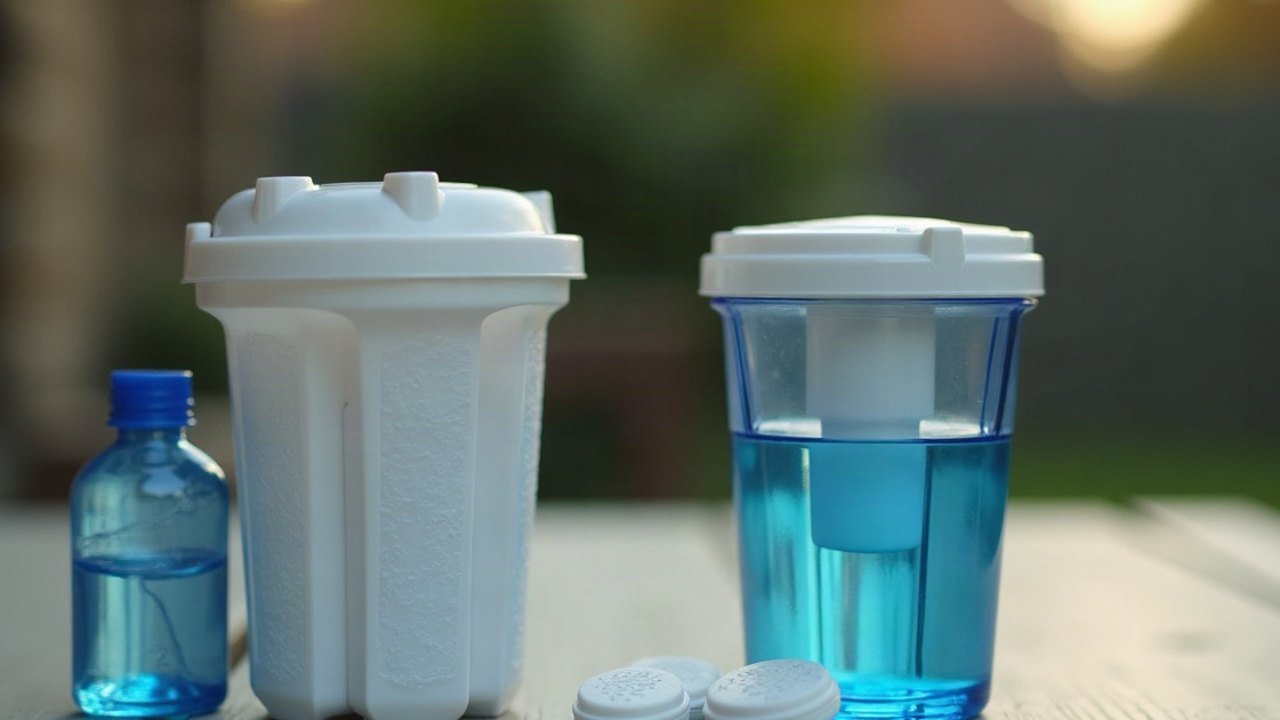
Filters versus tablets: the main differences
| Question | Portable microfilter | Disinfection tablets |
|---|---|---|
| What is the mechanism? | Physically retains particles and selected microbes | Chemically inactivates selected microorganisms |
| Protozoan parasites | Often strong when absolute pore size and test claims are appropriate | Ordinary chlorine or iodine unreliable for Cryptosporidium; some chlorine dioxide products can work with validated instructions |
| Bacteria | Can remove with sufficiently fine, intact membrane | Many products effective under correct dose and conditions |
| Viruses | Ordinary microfilters typically unreliable | Many suitable chemical disinfectants address them when used correctly |
| Visible sediment | Can remove it, but may clog | Usually does not remove it |
| Dissolved chemicals | Not reliably removed by ordinary microbiological microfilters | Not reliably removed |
| Time and effort | Physical pumping, squeezing or gravity flow; maintenance needed | Accurate dose, mixing and waiting time needed |
| Failure modes | Damaged membrane, bypass, clogging, freezing | Wrong product, dose, water condition, expiry or contact time |
This table describes broad classes. Some specialised units combine carbon, ultrafiltration, disinfection or reverse osmosis, and individual products vary. Always check the exact item's verified contaminant claims before assuming the table applies.
When a filter has the advantage
For a suitable water source where protozoan parasites or bacteria are a main concern, a correctly specified microfilter can physically retain them without requiring a chemical contact period. It may also improve clarity and reduce sediment. A gravity format can be convenient for filling several bottles, while a compact squeeze unit may suit one person.
The CDC advises checking absolute pore size and cyst-reduction claims rather than relying on marketing phrases. The filter's physical condition is crucial. Cracked membranes, damaged seals or freezing while wet can invalidate expectations.
But there is a major caveat: a microfilter removing visible particles and many bacteria can leave viruses behind. If the source has human sewage contamination or another credible virus risk, a filter-only approach may be inadequate. Our filter specification guide explains the mechanism and testing in more detail.
When a tablet has the advantage
Appropriate chemical disinfection can be compact and may address bacteria and viruses that ordinary microfilters cannot reliably exclude. Tablets have no fragile filtration membrane, although they must be stored according to their instructions and remain in date. They require accurate dosing to a known volume of water and sufficient contact time.
Cold, turbid or heavily contaminated water may affect the process. The CDC explains that chlorine, iodine and chlorine dioxide have differing organism coverage. In particular, ordinary iodine and chlorine are not dependable against Cryptosporidium. Specific chlorine dioxide products may work if their directions are followed.
Do not interpret “kills bacteria” as “removes sediment, metals, fuel and every parasite”. Tablets also have practical limitations for certain users, especially iodine products. For contact time, active ingredient and precautions, see the detailed tablet guide.
Why a filter and tablet together may be better than either alone
For a suitable natural source, one method can compensate for a gap in the other. A correctly chosen microfilter may physically exclude protozoan cysts and bacteria. A compatible disinfectant applied as directed to the filtered water may then address additional bacteria or viruses that could remain. This is a two-barrier approach, not a promise of perfect safety in every environment.
The CDC Yellow Book discusses filtering followed by chemical treatment when appropriate. The Wilderness Medical Society observes that in field conditions, source quality and user performance can differ from controlled laboratory testing. Both sources support thinking about complementary mechanisms.
The combination still does not remove an unknown chemical spill, and it does not excuse a damaged filter or incorrectly used tablets. If the hazard cannot be managed by the two verified methods, change the water source.
What happens in cold or muddy water?
Cold temperatures can slow certain chemical reactions, while sediment can shield organisms and consume disinfectant. Muddy water may also block a physical filter, reducing flow and tempting a user to push harder than the manufacturer allows. Clarification can sometimes help, but it does not itself guarantee potable water.
Consider a hypothetical rainy-day scenario: a small outdoor stream becomes brown with run-off. A filter may clog quickly; disinfectant labels may specify additional requirements for cloudy water; and run-off may introduce new chemical contaminants. The correct response might be to reject the source, not simply add more tablets.
Neither a printed filter flow rate nor a tablet's standard waiting time can be assumed to describe this changed situation. Follow validated instructions for the actual water conditions and choose a safer source if those conditions fall outside the product's scope.
Timing comparison: instantaneous flow versus contact time
A filter may deliver water as it passes through the membrane, but a slow gravity unit can still take considerable time to fill a household container. Tablets require a defined waiting period and often additional handling steps, but treating multiple bottles simultaneously may be convenient. There is no universal winner for speed.
Take an illustrative demand of six litres. If a particular filter delivers a measured 0.4 litre per minute, actual filtration flow would require roughly 15 minutes, excluding filling and cleaning. A tablet product could involve a different elapsed time based on its own instructions. It would be unsafe to invent a generic waiting period just to make the arithmetic comparison look tidy.
For a larger household, include the time required to collect water, remove sediment, perform verified treatment and protect containers. A method that looks quick in a marketing demonstration may be difficult for someone with limited hand strength or no safe working area.
Cost comparison: the number on the shelf is misleading
Rather than quoting volatile retail prices, compare cost per usable litre under your real circumstances. A reusable filter may have a higher initial cost and a manufacturer-specified cartridge life; tablets have a cost for each treated volume and may need replacing at expiry. But effective litres can be substantially fewer than the headline cartridge capacity if the element is damaged or repeatedly exposed to heavy sediment.
Here's an illustrative formula: filter purchase price plus realistic maintenance and replacement costs, divided by litres actually treated. For tablets: packet cost divided by total litres covered at the approved dose. Don't compare only purchase prices if one option requires consumables, fuel or additional equipment.
Buying the cheapest product that does not address the hazard is not saving money. If you already have access to verified safe alternative drinking water, buying either device may be unnecessary.
How to check a manufacturer's claims
For a filter, look for the exact model's pore-size specifications, independently certified contaminant reductions and operating limits. For a chemical product, check the active ingredient, organism coverage, dose, contact time and unsuitable conditions. A vague “99.9% safe” or “military grade” statement does not identify the organism or the testing protocol.
NSF explains why certifications such as NSF/ANSI 42, 53 and 58 address distinct aspects of water treatment. A filter tested for improving taste is not automatically certified for pathogen removal. For portable microbial purifiers, check the applicable test protocol and the exact independent evidence supporting the label.
Do not take a product photograph showing clear water as proof of microbiological performance. Most dangerous waterborne microorganisms cannot be seen with the naked eye.
Simple scenario decision matrix
| Scenario | More sensible first decision | Why |
|---|---|---|
| Local piped-water outage; official safe water distribution | Use verified replacement drinking water | Avoids unneeded home treatment of uncertain sources |
| Suitable outdoor source with likely protozoa and bacteria | Check an appropriate tested filter, with treatment for other risks as necessary | Physical removal may suit the anticipated microorganisms |
| Suitable source with credible virus exposure | Evaluate validated combined or alternative microbial treatment | Ordinary microfilters alone are not dependable against viruses |
| Water below industrial or fuel contamination | Avoid source; obtain safe alternative | Neither generic method reliably removes dissolved chemical hazards |
| Water under an official do-not-use notice | Follow the utility's exact restriction | Home equipment does not override a public health instruction |
This is a decision framework, not a certification of any water source. The word “suitable” in the examples means its hazards have been reasonably assessed and fall within the methods' validated capabilities. If that is unknown, do not infer suitability.
Maintaining the equipment after an emergency
A filter may require cleaning, drying, backflushing or replacement using the maker's directions. Some membranes can be ruined by freezing while wet. A tablet kit needs checking for packaging damage, moisture exposure and expiration. Keep instructions with the equipment, not only on an online product page that may be unavailable during an outage.
Store treated drinking water in a clean, closed, food-safe container. Using a dirty receptacle after successful disinfection can introduce organisms again. CDC guidance describes the importance of protected storage after treatment.
For longer-term container care and rotation, see how to store emergency water safely.
A practical comparison worksheet
- Write the intended water source and why you think it may be unsafe.
- List the possible hazards: bacteria, viruses, protozoa, chemicals or uncertainty.
- Check whether a known-safe alternative source exists.
- For every proposed filter, identify exactly which claims are tested and certified.
- For every proposed tablet, identify the active ingredient, dose and validated contact conditions.
- Estimate how many litres you need and the practical time and physical effort involved.
- Identify how you'll maintain the product and prevent recontamination.
- Reject a method if it cannot address a credible hazard or its instructions cannot be followed.
The outcome may be “filter”, “tablet”, “a validated combination”, “a different method” or “don't treat this source”. That last answer is often the most important one to keep available.
Frequently asked questions
Are purification tablets better than filters?
Neither is universally better. The answer depends on the source, microorganism coverage, treatment conditions and equipment. They have complementary strengths and different limitations.
Should I use tablets after a water filter?
It can be useful for suitable sources when the filter does not address a credible virus risk and the disinfectant is compatible and used exactly as instructed. It is not automatically needed for known-safe bottled water.
Which is faster for a family?
Compare actual measured filtration flow, validated tablet contact time and the volume needed. A fast-looking product may be slow to use at scale or in muddy water.
Will combining a filter and tablets remove fuel contamination?
No. Ordinary microbial filtration and disinfection do not reliably remove fuel or an unknown chemical spill. Choose another verified source.