A FILTER IS ONLY AS USEFUL AS THE HAZARDS IT HAS BEEN TESTED TO REMOVE.
A portable water filter is advertised as “0.1 micron”, “99.9999% effective” and “ideal for emergencies”. Does that mean you could safely drink any stream, flooded street or suspicious tap water through it? No. Those statements can describe genuinely useful filtration performance, but they do not establish protection against every microorganism, dissolved chemical or pollution event. The important questions are what was tested, against which hazard, under which conditions, and what happens when the filter is damaged or worn.
This guide explains what emergency water filters remove and what they do not. It helps you read test claims, choose a format for your circumstances and recognise when an alternative water source is the safer answer.
The CDC's consumer filtration guidance and the Wilderness Medical Society's 2024 clinical practice guidance both separate microbial removal, dissolved-chemical reduction and filter performance in real conditions. We use those distinctions throughout.
Start with the contaminant, not the filter
A water filter is only useful in relation to a particular problem. A pitcher that improves chlorine taste is not necessarily a wilderness filter. A hollow-fibre microfilter that physically excludes many bacteria and parasites may still allow viruses through. A reverse-osmosis unit can remove a broader range of dissolved material, but it has operating requirements and remains limited by its tested claims and condition.
The first question is not “Which brand is best?” but “What might be in this water?” If the source is a treated municipal supply with an issued boil-water notice, follow the exact water-company instructions. If it is a stream near livestock, microbial contamination may be a central concern. If it could contain fuel, industrial chemicals or flood debris, a general outdoor filter is not a dependable solution.
For a household water-service interruption, read what to do when the tap stops before treating an unknown source. You may have access to verified alternative water that makes home treatment unnecessary.
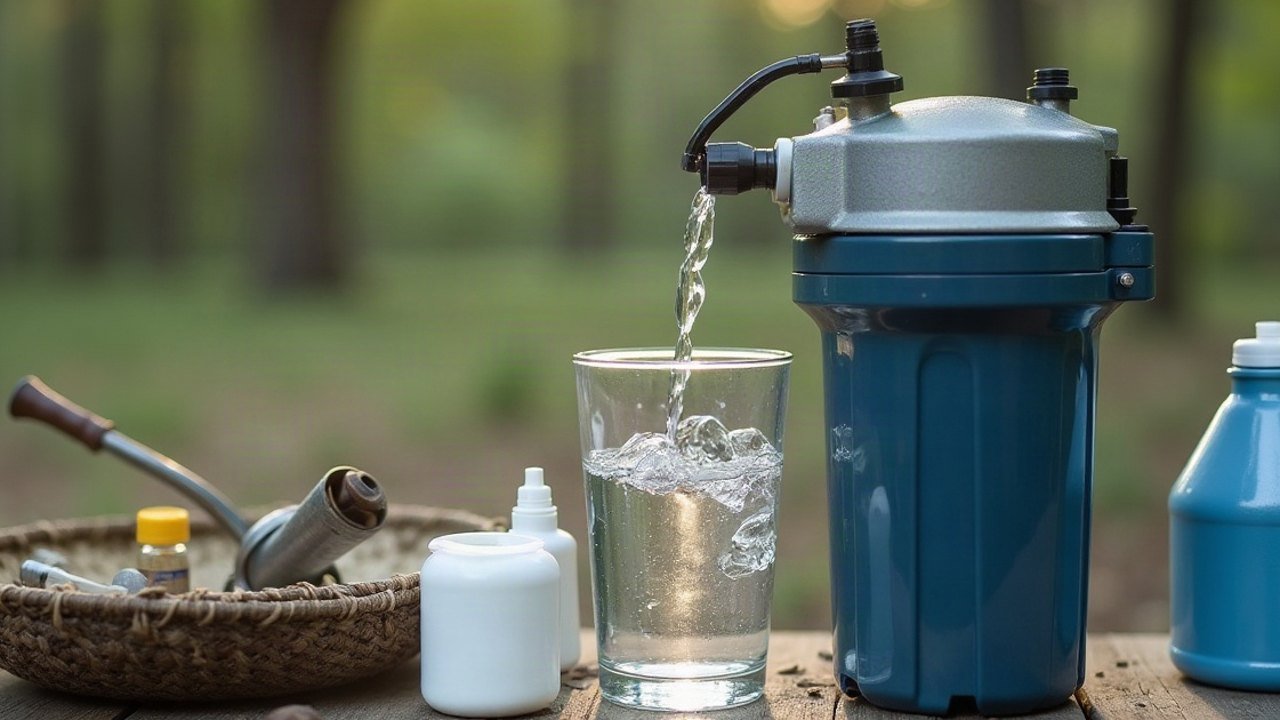
Four filtration categories and their different jobs
| Technology | Potential strengths | Key limitation |
|---|---|---|
| Activated carbon | Often improves chlorine taste and odour; specified designs can reduce certain chemicals | Not automatically a microbial disinfectant or universal toxin remover |
| Microfiltration, e.g. hollow fibre or ceramic | Correctly specified pores can retain many parasites and bacteria | Most conventional units do not reliably exclude viruses or dissolved chemicals |
| Ultrafiltration / nanofiltration | Finer barriers can reduce additional microorganisms, including some viruses depending on design | Performance and pressure requirements vary; chemical removal needs separate proof |
| Reverse osmosis | Can remove microbes, salts and certain dissolved substances under appropriate conditions | Requires the right pressure/operation, maintenance and claims for particular contaminants |
These categories describe processes, not product guarantees. A badly sealed cartridge or cracked membrane may perform differently from a properly fitted test specimen. The CDC's technology comparison explains microfiltration, ultrafiltration, nanofiltration and reverse osmosis in more detail.
What does 0.1 micron actually mean?
A micron (micrometre, µm) is one-thousandth of a millimetre. Filter pore sizes describe physical openings, but marketing may quote a nominal or an absolute value. A nominal rating may mean a percentage of particles at a stated size are retained, whereas an absolute rating is a more stringent specification under a defined test; neither term should be treated as a product-independent guarantee without the manufacturer's method.
The CDC advises looking for absolute pore size of 1 micron or smaller for parasites, and 0.3 micron or smaller for bacteria. Many viruses are smaller than those openings. The Wilderness Medical Society likewise notes that common field microfilters around 0.1–0.2µm remove bacteria and protozoa but do not reliably remove all viruses.
On its own, the phrase “0.1µm filter” does not explain whether the unit is intact, how it was tested or whether pressure can force a failure. Ask for the precise removal claim, test method and appropriate use.
Parasites, bacteria and viruses are different challenges
Giardia and Cryptosporidium are protozoan parasites often substantially larger than bacteria. A properly designed microfilter can physically retain them. Bacteria such as E. coli are smaller, which is why pore size and tested removal become important. Enteric viruses—including norovirus—may be smaller still, and ordinary backpacking microfilters cannot be assumed to remove them.
The CDC Yellow Book's water-disinfection chapter discusses how source conditions, sanitation and watershed activity influence the pathogens that matter. It notes that a microfilter may be paired with an appropriate disinfection method where virus exposure is a concern. A combined process still needs valid instructions for the actual source.
For how different chemical products compare against viruses and parasites, see our treatment-tablet contact-time guide. The filter question and disinfectant question are related but not interchangeable.
Do water filters remove fuel, chemicals or heavy metals?
Not by default. A hollow-fibre filter advertised for bacteria cannot be assumed to remove petrol, pesticides, solvents, lead or dissolved salts. Some activated-carbon and reverse-osmosis systems have documented reductions for certain chemicals. But the word “carbon” or “RO” does not demonstrate the removal of a particular pollutant from an unknown spill.
A product may be certified for a specific lead-reduction claim while having no verified claim for pesticides, and vice versa. Certain filter materials become exhausted; others are affected by poor flow, channeling or unsuitable water quality. If you suspect serious chemical contamination, choose a known-safe alternative source rather than attempting to build a chain of unverified filters.
The CDC's outdoor treatment advice explicitly warns that water containing harmful chemicals, toxins or radioactive materials cannot be made safe just by ordinary boiling or disinfection. It is a useful warning against overgeneralising filter claims too.
What do NSF/ANSI 42, 53 and 58 mean?
Independent standards provide a way to scrutinise claims, but a standard number is not a promise that every hazard is addressed. NSF's standards guide explains that NSF/ANSI 42 concerns aesthetic effects such as taste and odour. NSF/ANSI 53 addresses particular health-related contaminant reductions. NSF/ANSI 58 concerns reverse-osmosis drinking-water treatment systems.
Ask for the specific certified claim for the exact model and cartridge—for example, cyst reduction or a named chemical—not merely a logo displayed on a seller's product page. A standard can cover different performance claims; being certified for one does not establish certification for all others.
| Marketing statement | Better verification question |
|---|---|
| “NSF tested” | Tested by whom? Was the exact model independently certified, and for which contaminant? |
| “NSF 42 filter” | Which taste or aesthetic claim is actually listed? |
| “Certified to NSF 53” | Is it certified for cysts, lead or another named health claim? |
| “99.9999% purification” | Reduction of which organism, at what starting concentration and test conditions? |
| “Filters any water” | What are the stated exclusions, source-water conditions and membrane-life limits? |
NSF publishes product and certification information. Use the named certifier's searchable listing where available, check the exact model code and confirm which claims apply. Genuine paperwork is more informative than a star rating.
Gravity, squeeze, pump and straw: choose the format for the task
A gravity-fed system may be convenient for producing a batch of water without repeated pumping. A squeeze filter offers a compact format but can require hand strength and careful handling. A pump filter may suit certain sources, yet contains moving parts and needs maintenance. A drinking straw is portable but less convenient for preparing safe water for cooking or another person.
For a family, estimate the litres the chosen system could reasonably treat each day under real conditions. A device's maximum laboratory flow rate is not the same as the rate with silty water and a partly clogged cartridge. Consider whether anyone who depends on it has limited grip, mobility or vision.
The Wilderness Medical Society's practical treatment summary emphasises choosing a method around the source, group size, weight, fuel and duration, rather than assuming one format suits everyone.
Why a working filter can become unreliable
Filters clog, membranes can crack, seals can be damaged and poorly fitted cartridges may allow untreated water to bypass the intended media. Flow reduction is a maintenance signal, not an invitation to apply unlimited pressure. Some hollow-fibre filters may be damaged by freezing when water remains trapped inside. Manufacturer-specific freeze, storage and integrity instructions matter.
The Wilderness Medical Society warns that cracks and clogged elements can compromise performance. If you cannot verify the integrity of a used filter, don't use it as the sole treatment of high-risk water. Follow the maker's method for backflushing and cleaning; do not improvise chemicals or abrasive tools.
A useful practical check before any outage is to assemble the filter with clean water, confirm the parts fit and follow the maintenance instructions. This is an equipment-readiness test, not a microbiological laboratory certification.
Flow-rate numbers: plan around real output
Suppose a filter can realistically deliver 0.5 litre per minute in your own clean-water trial. Ten litres would take about twenty minutes of actual flow, excluding filling and cleaning time. If it drops to 0.2 litre per minute with a dirtier source, the same volume would take fifty minutes before extra maintenance. These are hypothetical arithmetic examples rather than published performance figures for a brand.
Record the output you actually measured. If the rate becomes very slow, check the product manual. Do not assume that forcing water through a clogged membrane will speed treatment safely. A sufficient daily volume matters as much as the filter's printed contaminant-removal claim.
Keep clean and untreated water physically separate
Cross-contamination can defeat a good filter. Dirty hands, the underside of a raw-water bottle, an unwashed cap or touching the outlet with the intake hose can introduce organisms after treatment. Arrange a clear raw-water side and a clean-water side on any table or work area. Label containers so others do not confuse them.
The CDC's safe-water storage guidance stresses clean containers and preventing recontamination after treatment. A tested filter does not make a dirty collection bottle permanently safe.
For cleaning, sealing and rotating your household water containers, read our emergency water-storage guide.
Three scenarios that require different decisions
A: Tap water tastes unpleasant but has no safety advisory. A correctly chosen taste-and-odour filter may improve palatability, although it does not establish a safety improvement. Check with your supplier if the taste is suddenly unusual.
B: Stream water near a campsite with human activity upstream. There may be pathogens not reliably removed by an ordinary microfilter. A validated treatment strategy and suitable source selection are necessary. The safer choice may be a known-safe supply rather than an uncertain stream.
C: Floodwater near a petrol station. Neither a camping microfilter nor an ordinary carbon jug is an adequate basis for declaring it potable. Potential fuel and chemical exposure calls for a different confirmed source. Do not drink it to test the filter.
Five questions before relying on a filter
- What source will it be used with, and what contaminants could realistically be present?
- Which exact microorganisms or chemicals does this particular model claim to remove?
- Where are the independent test reports or listed certification claims?
- What flow rate, maintenance and replacement are realistic for your household?
- What is the safer alternative if the filter breaks, freezes or cannot handle the source?
If you cannot answer the second or third question, the seller's “emergency safe” label is too vague to justify relying on the product. See our filters-versus-tablets comparison for how this analysis changes when comparing two treatment methods.
Frequently asked questions
Will a 0.1-micron water filter remove viruses?
Most ordinary microfilters around that pore size do not reliably remove all viruses. Check for a specific independently substantiated virus-reduction claim or use an appropriate combined treatment method.
Does NSF 53 mean a filter removes every dangerous contaminant?
No. Certification applies to named performance claims for a particular model. Check which health-related contaminants are actually listed.
Can a camping filter turn floodwater into safe drinking water?
Not reliably. Floodwater may contain pathogens and chemical pollutants beyond the filter's claims. Use a known-safe supply instead of assuming “clear after filtering” means potable.
How do I know when to replace a water-filter cartridge?
Follow the manufacturer's capacity, cleaning and integrity instructions. A damaged, frozen or incorrectly seated element may need replacement even if its nominal litre capacity has not been reached.