THE RIGHT WAITING TIME DEPENDS ON THE PRODUCT, WATER AND HAZARD.
You have a bottle of cloudy stream water and a packet of 'purification tablets'. The packet says to add a tablet and wait. Does that make the water safe to drink—and how long is long enough? It depends on what the tablets contain, which microorganisms may be present, the water's temperature and clarity, the manufacturer's validated instructions and whether the original source may contain chemicals.
This guide explains the limits, contact times and correct decisions around water-purification tablets without inventing a universal 'one tablet, 30 minutes' rule. The first preference during a household water interruption is a known-safe drinking-water supply or the water provider's specific instructions. For help deciding the amount of drinking water worth keeping available, see our emergency water quantity guide. Chemical tablets are an alternative for certain microbial risks, not a remedy for every contaminated source.
The US CDC's emergency water guidance distinguishes ordinary chlorine, iodine and chlorine dioxide. It explains that all may reduce some microbes when used correctly, but their ability to address resistant parasites differs markedly. Chemical or radioactive contamination is a separate problem that tablets cannot solve.
What do water-purification tablets actually do?
Most tablets marketed for drinking-water treatment contain a chemical that disinfects water by inactivating or killing certain organisms. Common active ingredients include chlorine-based compounds, chlorine dioxide and iodine-based compounds. The word 'purification' on a packet can overstate what that treatment accomplishes; the scientifically relevant question is which hazards the product has been demonstrated to address under which conditions.
For example, a product may be effective against many bacteria and viruses but not reliably against a resistant parasite. Disinfection also does not remove mud, microplastics, dissolved salts, fuel, pesticides or heavy metals. Filtering visible particles out of the water may improve disinfection conditions but does not magically remove every biological or chemical hazard.
| Treatment type | Can address | Important limit |
|---|---|---|
| Ordinary chlorine tablets | Many bacteria and viruses when correctly used | Unreliable against Cryptosporidium; performance affected by conditions |
| Iodine tablets | Many bacteria and viruses under suitable conditions | Not reliable against Cryptosporidium; additional use restrictions |
| Chlorine dioxide tablets | Many bacteria and viruses; some formulations claim parasite effectiveness | Parasite effectiveness depends on exact product and following validated instructions |
| Filtration alone | Depends on pore size, design and maintenance | Many portable filters do not remove viruses or chemical contaminants |
| Boiling | Very effective against microbial pathogens when done correctly | Does not remove fuel, many dissolved chemicals or radioactive contaminants |
The CDC's travel water-disinfection advice discusses this distinction, including why chlorine dioxide is treated differently from iodine and plain chlorine for Cryptosporidium. Use the specific product label for treatment volume and the correct contact time.
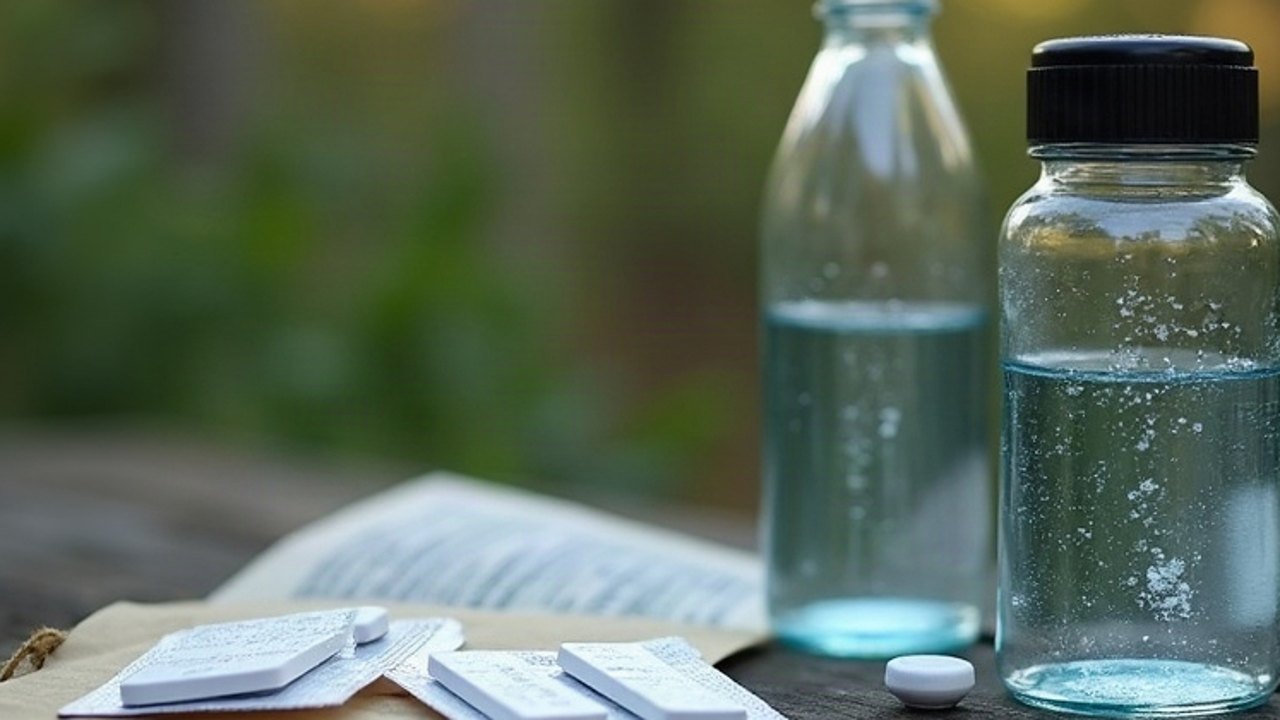
Why 'wait 30 minutes' is not a universal rule
Contact time is the period the disinfectant must remain in the water under specified conditions before it has achieved its stated treatment. That period varies with active ingredient, dose, organism, water temperature, pH, particle content and product design. Some organisms can be much harder to inactivate than others.
For instance, the UK outdoor-equipment manufacturer Lifesystems sells a chlorine dioxide product claiming activity against bacteria, viruses and certain cysts; it provides its own packet directions. But a contact time printed for one product, concentration or category of organisms should not be copied to a different chemical or treated as independently verified for all organisms.
A product intended for clear drinking-water treatment may require longer treatment or a different dose in cold or turbid water. If the label is missing, illegible or does not state how to treat your situation, do not guess from the contact time of another brand. Use a known-safe alternative or obtain the correct instructions from the manufacturer and a credible health authority.
Cryptosporidium is the decisive exception to many simple claims
Cryptosporidium is a parasite with a particularly resistant life stage. The CDC warns that iodine and ordinary chlorine tablets do not reliably kill it, whereas chlorine dioxide tablets can be effective if the correct product directions are followed. That caveat is essential. The mere phrase 'chlorine dioxide' does not establish that a quick treatment in freezing, dirty water is sufficient.
CDC household-treatment guidance recommends matching the method to the likely pathogen and notes the difference between chemical disinfection and physical removal. If a product has no clear claim or verified instructions for resistant protozoa, don't assume that it covers them.
Water from a stream can contain more than one type of hazard. If there is any reason to suspect contamination by sewage, livestock waste or animal activity, carefully consider more robust treatment and seek suitable guidance. Even a properly used chemical treatment cannot correct an unknown industrial pollutant.
What cold water and visible particles do to treatment
Cold water can slow chemical disinfection, while soil and other suspended material can shield organisms or consume some disinfectant. A bottle that looks reasonably clear is not guaranteed microbiologically safe. Conversely, water that is visibly muddy is a warning that a simple tablet calculation may be unreliable.
The CDC advises removing sediment by settling or filtering through clean cloth before further microbial disinfection when suitable, while stressing that the actual disinfectant dose and method must match the conditions. This preclarification is not a substitute for disinfection and cannot reliably remove chemical pollution.
If you cannot reasonably establish that a source is suitable for chemical treatment, obtain known-safe water rather than trying a random combination of tablets, powders and a coffee filter. Mixing chemicals or increasing the dose beyond instructions may introduce additional risks.
How to read the product label properly
Before using a packet, check the active ingredient, intended water volume, number of tablets, minimum contact time, temperature limitations, clarity requirements, expiry date and any restrictions on users. Some packs distinguish different treatment conditions; others do not include sufficient guidance for the contamination you suspect.
| Label question | Why it matters | If the answer is unknown |
|---|---|---|
| What is the active ingredient? | Organism coverage differs between iodine, chlorine and chlorine dioxide | Do not treat the product as interchangeable |
| What exact volume does one tablet treat? | Too little active ingredient may be ineffective | Do not estimate by tablet size or colour |
| What waiting time is specified? | Disinfection needs sufficient contact time | Obtain the original instructions or avoid use |
| Does the product address parasites? | Cryptosporidium is resistant to common methods | Do not infer protection from a generic 'kills germs' claim |
| Are there temperature/turbidity rules? | Cold and suspended material can reduce efficacy | Do not assume the normal-dose example applies |
| Has the packet expired or been damaged? | Effective ingredient stability may change | Use a suitable in-date alternative |
If a product's marketing page and instructions differ, obtain clarification from the manufacturer rather than choosing whichever claim is more convenient. A broad marketing statement that a tablet 'kills everything' is not a safe basis for treating an uncertain source.
A safe decision sequence for an uncertain source
- Identify the source. Is it treated tap water under a current notice, a cleanly stored supply, rainwater, stream water or floodwater? The origin determines likely hazards.
- Check for chemical-risk clues. Fuel odour, an industrial spill, pesticide use, mining activity, floodwater or a supplier's do-not-use instruction are reasons to avoid chemical-tablet assumptions.
- Prefer known-safe water. Use intact commercial drinking water or an approved public supply where available.
- Determine whether a tablet is suitable. Compare the active ingredient and validated coverage with the suspected microbial risk.
- Follow the exact packet directions. Use the stated volume, dose, contact time and water-condition requirements. Do not substitute directions from another product.
- Protect the treated water. Use a clean container and avoid touching the inside of the cap or dipping dirty items into it.
- Reassess uncertainty. If the source may contain contaminants the treatment cannot remove, don't drink it just because the tablet has dissolved.
This sequence is about avoiding unreliable shortcuts. It is not a guarantee that every unknown natural water source becomes potable through home treatment. If a water supplier has issued a notice, its instructions take precedence over a general camping guide.
When not to use tablets at all
Suspected petrol, diesel, pesticides, solvents, industrial chemicals, heavy metals, toxic algal contamination or radioactive material are not problems you can reliably fix with a disinfection tablet. The CDC's outdoor water-treatment guidance explicitly warns that boiling and disinfection do not make chemically or radioactively contaminated water safe.
Do not treat water from floodwater that may contain fuel or sewage as an ordinary clear stream. Don't interpret a lack of odour as proof of safety: some dangerous contaminants have no obvious smell. Use known-safe bottled water or guidance from the responsible local public-health or water authority.
Water-purification tablets should also not be used in place of the proper method for preparing infant formula or specialist medical use. Follow the NHS formula-preparation guidance and clinical advice where relevant. Ordinary treated camping water is not automatically suitable for every medical purpose.
Iodine has specific user restrictions
The CDC advises avoiding iodine-treated water if you are pregnant, have thyroid problems or are sensitive to iodine; it also warns against relying on it for prolonged periods. This is not an invitation to modify the dose until it tastes acceptable. Follow medical advice or choose a more suitable known-safe water source.
All drinking-water chemicals should be stored securely away from children and used only for their intended purpose. Don't mix different treatment products or household chemicals, and do not put purification tablets into beverages other than the specified water volume. An extra tablet is not automatically a safer tablet.
If somebody feels unwell after consuming suspect water, contact an appropriate healthcare professional and tell them the source and treatment used. Retain the product packaging if possible without contaminating other items.
How tablets compare with filters and boiling
Boiling clear water is an effective method for killing microbial pathogens when correctly performed, but it needs a safe heat source and does not remove chemical contaminants. Certain filters can physically remove parasites and bacteria, depending on their pore size and tested specification; many ordinary backpacking filters do not remove viruses. Some users choose to filter and then disinfect appropriate water under the relevant product directions.
The CDC's traveller guidance distinguishes microfiltration, reverse osmosis and disinfection. A cheap filter advertised as 'removes bacteria' is not automatically effective against viruses, dissolved chemicals or salts.
A useful decision starts with the contaminant of concern. For an unknown floodwater source, neither a tablet nor a generic hiking filter is a reliable catch-all solution. For a safely stored emergency supply, adding tablets may be unnecessary. For an appropriate natural source, the correct combination depends on verified product specifications and conditions.
Make treatment safe to handle and easy to document
If you use approved tablets as directed, keep the original packet and product directions with the treatment kit, protected from moisture and heat. Mark the treated container's date and time, water volume and the time at which the specified contact period will have ended. A basic note helps stop somebody drinking prematurely while the water is still undergoing treatment.
Keep treated and untreated containers separate and avoid recontaminating water when pouring. Do not use the same dirty lid, scoop or drinking vessel across both. Safe handling after treatment matters because tablets do not create a permanently sterile bottle that cannot be contaminated again.
The CDC's water-storage guidance describes clean, closed containers and protected storage. For longer-term household storage, see our container cleaning and rotation guide.
A practical product comparison without assuming the brand is the evidence
Consider two actual product categories sold by the same UK manufacturer: Lifesystems chlorine tablets and Lifesystems chlorine dioxide tablets. Its product descriptions make different organism-coverage claims. That difference alone shows why 'purification tablets' should not be treated as a single universal product.
The manufacturer's directions and the actual product edition should be consulted for volume and waiting time, and any resistant-parasite claim evaluated against appropriate public-health guidance. Do not apply a remembered dose from an old packet to a new formulation. This article does not endorse either product or promise that any single pack can render an unknown source safe.
Frequently asked questions
How long do water-purification tablets take to work?
There is no single contact time for all tablets. Follow the exact product's validated directions for active ingredient, water volume, temperature, clarity and target organisms. Don't copy a waiting time from another chemical or brand.
Do water-purification tablets kill Cryptosporidium?
Ordinary iodine and chlorine tablets are not reliable against Cryptosporidium. Chlorine dioxide products can be effective when used according to appropriate validated instructions; verify the specific product and conditions.
Can tablets make floodwater safe to drink?
Not reliably. Floodwater can contain fuel, toxic chemicals and other hazards that disinfection cannot remove. Use a known-safe alternative and follow the responsible water or public-health authority's instructions.
Are purification tablets safe for infant formula?
Do not assume chemically treated camping water is suitable for formula preparation. Follow NHS formula guidance and obtain qualified advice if safe water or heating is unavailable.