ACT ON YOUR ACTUAL LOCAL THREAT—NOT THE MOST DRAMATIC VERSION OF A HEADLINE.
News breaks that a major international war has begun. You have family in another country, your phone is receiving unverified messages and nobody knows whether the immediate threat is local. What should a civilian do in the first 24 hours? First establish where the danger actually is. A declaration or headline about war is not the same as an air-raid warning for your area, and the correct response to an imminent strike is not the same as the response to a distant conflict.
This first-24-hours guide for a possible World War III outbreak gives a practical sequence for verifying information, protecting people, maintaining essential services and deciding whether to shelter or leave. The timeline is for situations where there is time to assess: if there is immediate danger, act on the specific emergency and local professional instructions without waiting for any step below. For advance preparation see the civilian war-readiness guide.
Two situations require different immediate actions
| Situation | First action | Do not assume |
|---|---|---|
| Major fighting reported overseas with no local warning | Check verified news and UK authorities for any local implications | Your town is under attack or that immediate evacuation is necessary |
| Official emergency warning for your location | Read and follow the incident-specific instruction | Generic household advice overrides a live safety warning |
| Explosions, visible smoke, fire or other immediate danger nearby | Take appropriate immediate protective action, use safe cover or escape as conditions require and seek emergency help | There is time to pack, film events or inspect debris |
| Power or communication services suddenly fail | Assess the actual outage and any care/safety needs, then use known backup channels | A cyberattack or wider war is proven by the outage itself |
In the UK call 999 or 112 for immediate danger where an appropriate network operates. If abroad, know the correct local number. A family should not start a long drive because a social-media post claims that “every city will be hit next”.
First 15 minutes: protect people and identify the actual event
If there is no local immediate danger, check the welfare and location of people in your home. Identify whether someone relies on powered medical equipment, urgent medication or care assistance. Find the source and time of the news: an official announcement, a reputable broadcaster and any location-specific warning are more useful than a dramatic repost without a date.
The UK Emergency Alerts service sends some life-threatening warnings to compatible devices in affected areas, but it is not a comprehensive wartime siren network and not every event generates an alert. If you receive a genuine alert, follow its instructions. Do not treat an email asking for personal details as an emergency alert; GOV.UK states the service does not use that process.
Write down the confirmed incident, location and the time it was last updated. The first goal is clarity, not collecting as many rumours as possible.
If an attack appears to be happening near you
Immediate blast and fragmentation hazards can be lethal. If there is a verified warning of imminent attack, use the designated shelter or official protective instructions for your area. If you are suddenly exposed to nearby explosions, seek substantial available protection, move away from windows where that can be done safely, and avoid exposing yourself outdoors to watch or film. No ordinary room guarantees protection from a direct hit.
Do not approach damaged structures, fallen wires, suspicious metal objects or possible unexploded munitions. The ICRC's field-based analysis identifies blast, fragments, collapse and lingering explosive remnants as major civilian hazards in populated areas. If routes are obstructed by fire, debris or smoke, don't force a hazardous escape merely because an old map lists that exit.
For a fire in your own home, follow the relevant fire escape procedure; for fire elsewhere in a block, use that building's specific strategy and fire-service directions. If a nuclear or chemical incident is identified, protective instructions may differ significantly, so do not use this ordinary blast guidance as a substitute.
Minutes 15–60: choose reliable information channels
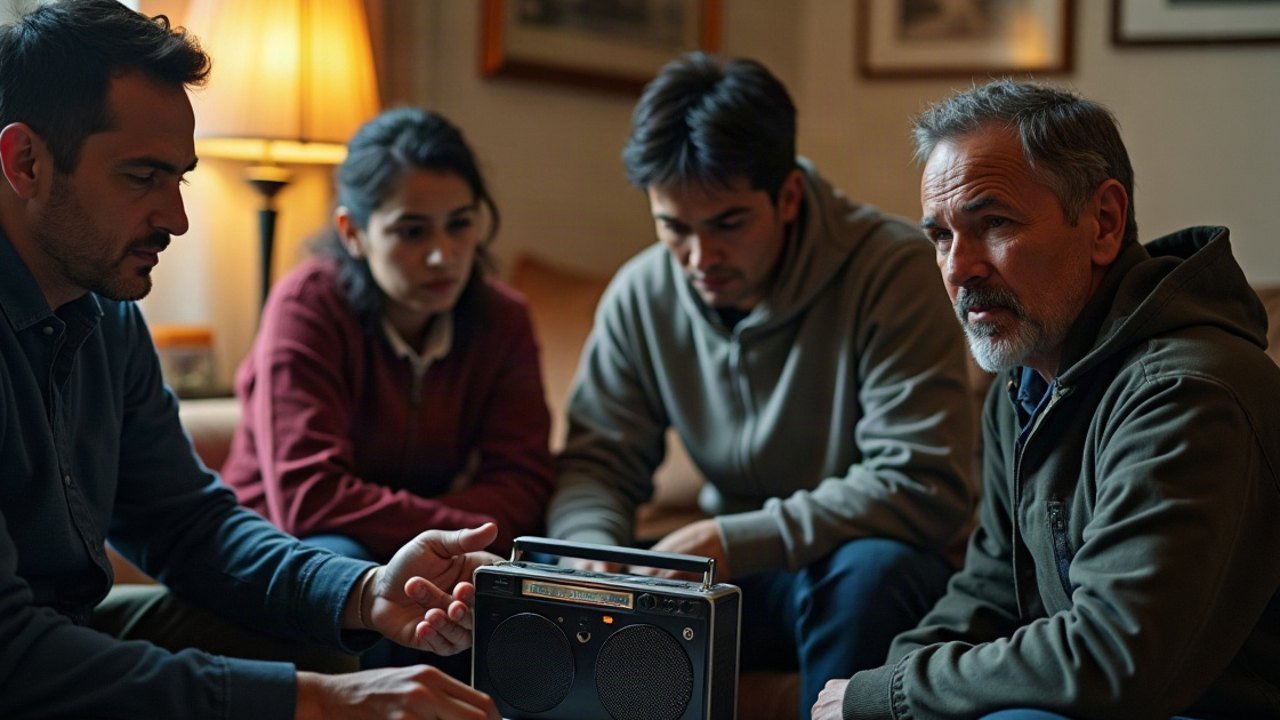
Identify two usable sources that do not rely on the same service. For a UK household those might be a trusted official online service while mobile data works and a working battery FM/DAB receiver if broadband fails. A phone with no Wi-Fi can sometimes still use a mobile network; a radio broadcast can still work while a home router has no power.
Write down where updates are coming from and whether they concern your actual address. The UK government's alerts guidance distinguishes national Emergency Alerts, flood, weather and local warnings. There is no reason to assume one broadcast covers every threat at every location.
For people abroad, use credible local authorities, verified humanitarian updates and relevant travel/consular channels. Avoid trying to decode military movements from viral videos when the decision you need is whether a road, hospital or shelter is safe.
Make the household contact pass once, clearly
Once immediate safety is established, send a concise message to essential contacts: your confirmed location, status, next action and when you will update if service allows. When networks are strained, repeated calls to everyone at once may make coordination harder. An agreed trusted relay can pass updates without each relative making the same inquiries.
Example: “We are home in Preston, safe, no local warning at 09:30. Staying here and monitoring official information. Next update at midday if coverage works.” Do not send precise personal location publicly unless necessary and appropriate.
If someone is at school or in care, check the provider's current instructions rather than demanding that they leave through an unsafe route. A missed message could mean network failure; it is not proof that a person has been injured. The family check-in sheet helps specify the relay and fallback before a crisis.
Hour 1–3: assess the home as it is now
Check whether electricity, safe water, heating, ventilation, sanitation and communications are functioning. For each issue, separate confirmed failure from anticipated concern. A country declaring war does not show that the water supply is contaminated; a live local water-quality notice does require the stated action.
| System | What to confirm | Practical fallback |
|---|---|---|
| Essential medical care | Required treatment, equipment power and provider instructions | Approved clinical contingency and verified provider route |
| Drinking water | Current supply and any official quality notice | Known-safe stored water; supplier instructions |
| Electricity and phone power | Actual local fault, usable devices and battery levels | Battery lighting and tested charging arrangement |
| Information | Which channels still work and carry dated local updates | Independent radio and saved official contacts |
| Food | Usable pantry food, cooking/refrigeration status | Familiar safe no-cook meals where appropriate |
| Transport | Any official route closures or evacuation instructions | Only verified safe destinations and alternatives |
Check priorities without creating new hazards: don't disconnect medical devices to test them, light indoor camping stoves or put water containers on unsafe shelves. Our home supply guide has detailed quantities; this article is about first-day decisions.
Hour 1–3: decide whether staying is currently safe
If the home is safe, essential needs can be met and there is no contrary instruction, remaining and monitoring may be appropriate. If an actual local incident makes the building unsafe or emergency services direct evacuation, the decision changes. A person whose medically necessary equipment cannot operate may need professional support even without external attacks nearby.
The shelter-or-evacuate framework distinguishes immediate danger, current warnings, habitable conditions and safe routes. Do not use a prepared plan as an excuse to remain in a burning building or drive through floodwater. No single shelter choice fits conventional explosions, chemical releases, floods and radiation events.
Hour 3–6: prepare essentials only if it is safe to do so
If there is time, ensure important identity and care documents are accessible, put suitable clothing and essential medicines where authorised people can retrieve them and check the contact sheet. Confirm where children, dependants and pets are and who is responsible for them. Do not delay an instructed escape to complete a packing list.
For departure, pack a realistic load suited to the route: water for the journey, safe food, prescribed care supplies, contacts, keys, light and appropriate clothes. Avoid heavy specialist gear that would slow movement. Our family go-bag system covers who carries what, while the evacuation plan covers routes and reunification.
Do not announce your departure route publicly or share sensitive documents with strangers offering “guaranteed safe passage”.
Hour 3–6: treat travel information as perishable
An airport, road, border or train route can change status rapidly. A screenshot from earlier in the day may be obsolete. If travel becomes necessary, confirm the destination, transport, permissions and route through verified current sources. Leave room for an alternative if the first route becomes unavailable.
The UNHCR's humanitarian evacuation guidance stresses safe passage, people with additional needs, documents and family unity. An announced humanitarian route is not automatically a safe one until it is genuinely agreed and usable under current conditions.
If someone is trapped near active fighting, seeking qualified local assistance may be safer than improvising a journey towards a border or unverified gathering point.
Hour 6–12: manage service dependencies, not rumours
Monitor any confirmed outages and the next expected official update. If the power is out, conserve phone energy while keeping a way to receive relevant warnings. If water service is affected, follow the supplier's specific quality and supply notices. If prescribed medicine is running low, contact the appropriate care route while it remains available rather than trying to substitute a different medication.
Information overload is itself a problem: a stream of conflicting stories can make people change plans repeatedly. Keep a brief log: source, time, confirmed fact, required action, next review. Avoid acting on claims that all banks are closed or all roads are blocked without relevant verification.
The ICRC's report on indirect effects of urban warfare explains why water, electricity and healthcare disruptions can extend beyond immediate attacks. That possibility is a reason to check dependencies, not proof that every service is about to stop.
Hour 12–24: reassess the decision with fresh evidence
Conditions can evolve significantly during the first day. Compare the original information with updated official warnings and the actual household situation. Is the home still habitable? Are critical care needs supported? Do contacts know your status? Is the planned destination operating? Are routes or restrictions different?
Use a simple decision statement: “At [time], our current action is [remain / prepare / leave as directed] because [confirmed facts]. We will reassess if [specific trigger].” Writing it down can stop a group from arguing over conflicting memories of an old announcement.
If no local impact has occurred, the responsible outcome may be to continue ordinary activity while checking appropriate updates. If danger has increased, follow the specific emergency procedure. The timeline does not require an invented escalation merely because 24 hours have passed.
What to avoid during the first day
| Tempting action | Why it can make things worse | Better response |
|---|---|---|
| Drive immediately on hearing “world war” | May enter congestion, closure or a more dangerous area | Verify current local threat, instruction, route and destination |
| Go outside to film an explosion or inspect debris | Exposure to further strikes, smoke, unstable structures and remnants | Seek appropriate immediate protection and emergency help |
| Buy large amounts of food based on an online rumour | Can create shortages and waste money | Assess actual supplies and buy normal necessary quantities |
| Share a screenshot of a secret “evacuation order” | May spread disinformation and send people into danger | Check the issuing authority and date through an independent route |
| Take iodine as a general war precaution | Not general protection against radiation and can be medically inappropriate | Follow specific public-health directions for a verified incident |
| Ignore a current local warning because a kit is ready | Supplies cannot make unsafe buildings or routes safe | Follow verified hazard-specific guidance |
Different first-day circumstances: three examples
Example A — war overseas, UK services normal: A family checks reputable news and local authorities, contacts relatives abroad using ordinary channels, confirms its essential numbers and avoids unnecessary travel. There is no basis to assume an air attack is occurring on their street.
Example B — local services disrupted but no physical attack: A household checks its electricity provider, maintains essential care, uses a working battery radio and follows any actual local notices. A failed router doesn't prove that national communications have collapsed.
Example C — an official local attack warning: The family follows specific protective instructions and prioritises immediate safety. A general water checklist or six-hour schedule is irrelevant until the immediate hazard is managed.
These examples show different decisions, not different attitudes towards the seriousness of war. Each is guided by actual conditions.
When relatives cannot be reached
Contact may be interrupted by damage, congestion, restrictions or loss of battery. Log the last confirmed location and time, avoid spreading unverified claims about their fate, and use appropriate official or humanitarian help where available.
For relatives separated by conflict, the British Red Cross international family tracing service and ICRC Restoring Family Links can help eligible cases. Their work requires individual assessment and may take time.
Frequently asked questions
Should I leave home immediately if World War III is announced?
Not solely on the basis of an international news headline. Act on your actual local threat, official instructions, safe route and destination. Immediate hazards require immediate protective action.
What should I do if an explosion occurs nearby?
Seek suitable immediate protection, avoid windows and exposed areas where safe to do so, follow local instructions and seek emergency help. Do not approach damaged areas or suspicious debris.
Can I rely on my phone for every emergency warning?
No. Devices, power and networks can fail, and not every event produces an alert. Know other trusted information routes such as an appropriate broadcast radio.
What should I have decided by the end of the first day?
Who is accounted for, which local hazards are confirmed, whether current accommodation remains safe, how essential care can continue and what verified condition would change the plan.
Research and further reading
- UK Emergency Alerts — official warnings and how to interpret them.
- UK Be Ready — warnings, updates and independent channels.
- ICRC — direct and indirect harm to civilians from explosive weapons.
- ICRC — cascading loss of essential services in urban conflict.
- UNHCR — safe evacuation and civilian protection conditions.
- British Red Cross — help finding family separated by conflict.