A FAMILY KIT ONLY WORKS WHEN IT MEETS THE REAL NEEDS OF PEOPLE AND ANIMALS.
Two households may own identical emergency backpacks and have completely different safety needs. One has a toddler with food allergies; another has an anxious rescue dog, a cat that hides at the sight of a carrier and a child still using nappies. A generic “72-hour kit for everyone” misses the point if it doesn't account for safe feeding, identification, medicines, handling and a realistic place to go.
This guide explains how to tailor an emergency survival kit for families with children or pets, including infants, school-age children, dogs, cats and small animals. It concentrates on the contents and safe-use procedures, not the assignment of family departure roles covered in our family go-bag system.
Make an individual-needs table before filling the bag
Write each dependent person's or animal's requirements in four categories: food and water, health and medicine, comfort and safety, identification and transport. Record a suitable backup for a missing item. A child's age and a pet's size can change the supplies needed dramatically.
| Family member or animal | Irreplaceable needs | Who can confirm the right arrangement? |
|---|---|---|
| Infant using formula | Safe ready-to-feed formula or authorised safe preparation method, sterile feeding supplies | Parent/carer and relevant NHS or feeding professional guidance |
| Young child | Age-appropriate food, medication, nappies/toileting, clothing, comfort item | Responsible caregiver, school or care provider where relevant |
| Older child | Suitable portions, medication, reliable adult contact and age-appropriate safe instructions | Parent/carer and authorised school arrangements |
| Dog | Food, water, lead, secure harness, medicine, identification and a permitted destination | Owner, veterinarian and destination host |
| Cat, rabbit or small animal | Correct secure carrier, species-appropriate food, water, bedding, medicine | Owner, veterinarian and suitable accommodation |
For humans who depend on specialist medical supplies, obtain an individual clinical contingency from the relevant team. A standard first-aid box is not a substitute for their prescribed treatment. For animals, the veterinary practice is a useful source for medicine continuity and safe transport instructions.
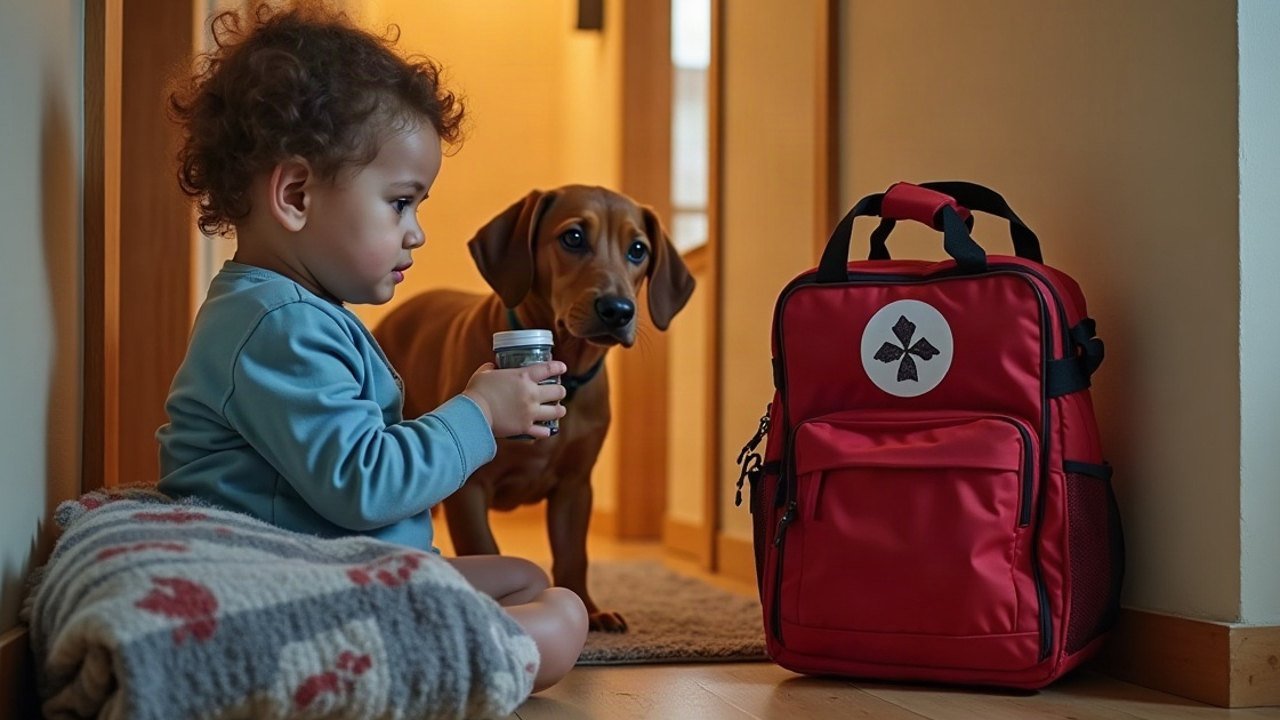
Separate home reserves from departure supplies
Home reserves can hold bulk food, water and hygiene materials; a departure kit must be something the assigned adult can transport while supporting dependants. The two should not be packed as though they are identical.
A sensible system may have a small adult grab bag for contacts and essentials, a protected child-specific module, and an animal carrier with a labelled pet pouch. Keep everything in known safe locations rather than assuming children can carry critical medicines or pets will walk voluntarily when frightened.
Use the 72-hour home-kit guide for ordinary family quantities, and the carry-weight guide to evaluate how much one person can manage safely. The calculation must include holding a child's hand, carrying a baby or securing a carrier, not just backpack weight.
Infant feeding: ready-to-feed is different from powdered formula
The Food Standards Agency's 2 November 2026 guidance addresses disrupted or unsafe water supplies. It says ready-to-feed liquid infant formula is the safest option where access to safe water is limited, provided suitable clean and sterilised feeding equipment is used. Powdered infant formula is not sterile, and sealed bottled water is not sterile either.
For powdered formula, NHS advice requires preparation with freshly boiled water that remains at least 70°C when mixed with the powder, followed by safe cooling. Do not assume a room-temperature bottle of water is an adequate replacement, or dilute formula to stretch supplies. In a combined power-and-water outage, preparing powder safely may not be possible without a suitable safe heating method and clean equipment.
The NHS instructions for making up baby formula provide the normal procedure. For children with specialised feeding needs, follow their clinical plan rather than generic advice.
Calculate infant supplies according to the real feeding routine
Ask how many feeds, nappies and changes of clothes are used over a typical day. For a three-day planning period, count actual daily use × three, adding a reasonable margin for delays and leakage within safe storage constraints. Don't assume every infant uses the same number of feeds or that normal volumes should be altered.
Keep current feeding instructions with authorised carers, and rotate ready-to-feed products according to manufacturer dates and handling guidance. Once a carton is opened, its safe-use conditions change; follow the exact package instructions. Do not plan to keep prepared feeds unrefrigerated beyond relevant guidance.
For travel, the FSA also describes safe handling options and limitations when making a fresh feed isn't possible. Avoid treating a cool bag as indefinite refrigeration; time and temperature matter. A small suitable storage plan is more valuable than an oversized bag of powdered food that cannot be prepared safely.
Children with allergies or other specific dietary needs
Keep familiar, age-appropriate safe food that matches medically required restrictions. A generic cereal bar may contain nuts or other allergens; a tin may be unsuitable for a child with swallowing difficulties. Include the necessary utensils and a hygienic method for serving food when normal washing or refrigeration is unavailable.
If a child has prescribed emergency medication such as an adrenaline auto-injector, follow their actual clinical action plan and storage instructions. Don't add unprescribed medicines or create doses from an internet checklist. Ensure a responsible adult knows where the medication and instructions are kept.
Use the balanced no-cook meal guide for general meal construction. The child-specific point is verifying age, portion, allergy and preparation safety—not simply multiplying adult portions by the number of children.
Water planning for people and animals
The British Red Cross uses a household planning reference of approximately 2.5–3 litres of drinking water per person per day. Additional needs apply for infant feeding, hygiene, illness and relevant medical conditions. Pets also require drinking water, but quantities vary greatly by species, size, food and health.
Do not apply human drinking-water figures to a kitten or a dog, or decide an infant's formula needs using the adult hydration estimate. Ask a veterinary professional about a pet's needs where uncertain, and follow clinical advice for medically complex children.
Carrying all water in the departure bag is often impractical. Keep home reserves separately, choose safe destinations that can provide suitable water and carry an appropriate amount for the actual journey.
Pet carriers are safety equipment, not optional accessories
A frightened cat cannot reliably be carried loose; a rabbit may struggle or injure itself; a dog may escape when a door opens in an unfamiliar environment. The Blue Cross, with veterinary review, recommends secure carriers for cats and small pets, sturdy leads for dogs, up-to-date identification and a destination outside the affected area where appropriate.
Check that the carrier is secure, suitably ventilated, fits the animal and can be lifted safely. For pets unfamiliar with carriers, gradually introduce the equipment during ordinary calm days using appropriate welfare-friendly methods. A carrier hidden at the back of a loft is not ready to use.
Keep a lead or harness and carrier near a safe accessible location without obstructing any fire route. Never attempt to recover an animal by re-entering a burning or otherwise unsafe building.
What belongs in the animal-specific pouch?
| Item | Why it is useful | Condition to check |
|---|---|---|
| Normal food and suitable bowls | Avoids abrupt diet changes during travel or a disrupted home routine | Enough for the planned period; sealed and age/species appropriate |
| Safe drinking-water provision | Supports the journey and time at destination | Accessible bowls and actual source of safe water |
| Prescribed veterinary medication | Care continuity for particular animals | Correct instructions, storage and vet contact |
| Lead, harness, carrier or enclosure | Prevents escape and supports safe transport | Correct fit, secure fastenings, animal acclimatised where possible |
| Identification, records and photo | Helps with reunion and veterinary care | Microchip registration and contact details current |
| Waste bags, suitable litter, bedding | Hygiene, comfort and animal welfare | Safe for species; manageable in transport |
In its flood advice, Blue Cross recommends a current photograph, vet details, vaccination paperwork and a way to identify the animal if separated. These are more useful than buying novel pet gadgets whose safety and benefit are unclear.
Microchip details matter more than a flashy collar
A pet's identity tag or microchip is helpful only if the registered owner contact details are current. Check the record before a journey or a change of address. A microchip does not act as GPS and does not tell you where a missing animal is; it permits identification when scanned by an appropriate reader.
Keep the microchip number and vet details in a protected paper or offline record, and a recent photograph where accessible to an authorised helper. For dogs and cats in England, applicable microchipping and registration obligations must also be followed. Avoid publishing identification numbers or private addresses unnecessarily.
Choose an actual pet-friendly destination
Some friends, relatives, hotels or emergency accommodation providers cannot accept animals, particularly multiple pets or exotic species. Phone ahead when possible and record a genuine alternative. A planned destination may also be affected by flooding, transport disruption or fire restrictions.
The Blue Cross advises arranging for animals to stay with a trusted person outside a flood-risk area where appropriate, and having a plan for when an owner is absent. For assistance animals and disabled owners, accommodation needs require particular care and must not be treated as an ordinary optional pet matter.
For larger animals, reptiles, birds or species needing controlled heat, water, UV or specialist habitat, get species-specific advice from an experienced keeper or veterinary professional. A standard carrier and dog-food list is not appropriate for every animal.
Comfort can prevent practical handling problems
A familiar lightweight item, spare dry clothing and a calm, consistent routine may help a child tolerate delays. For a dog or cat, familiar bedding or an appropriate toy can reduce distress and help the animal settle in a carrier or temporary accommodation. Comfort items are not a reason to overload the bag with unnecessary gear.
Explain ordinary household plans to children using age-appropriate language. A child at school must follow existing safeguarding arrangements; a family emergency kit is not permission for an unaccompanied child to leave school or travel through a dangerous area.
For pets, practise routine carrier handling without creating a frightening simulation. Ask your vet for advice if handling creates a risk of bites, scratches, panic or injury.
Run a dependent-needs audit, not a frightening evacuation drill
- For each child or animal, list necessary food, water, medication, transport and care instructions.
- Check opening and closing the actual carrier with the animal only during an ordinary welfare-friendly familiarisation, where safe.
- Ask who can collect the child's medically necessary items or the animal's equipment if the usual adult is absent.
- Test whether an adult can lift the packed carrier and support children without exceeding their safe ability.
- Confirm the destination can receive the people and animals involved.
- Review product dates, microchip information, prescription changes and current caregiver contacts.
- Document genuine remaining gaps; ask the appropriate clinician or vet where needed.
Do not practise by withholding food, switching off life-sustaining equipment, frightening an animal or creating a false fire alarm. The exercise should identify weaknesses without creating harm.
One example: a toddler, a dog and a cancelled car journey
Suppose a household plans to stay with relatives during a local water disruption. Their prepared bags contain toddler clothing, food suitable for an allergy, safe feeding items and the dog's carrier or harness. Then their car is unavailable. The useful question is not “Do we have the bag?” but “Can the assigned adult safely carry the child supplies, secure the dog and reach an alternative destination?”
It may be safer to arrange appropriate transport or remain in a suitable safe place while getting advice than to attempt a lengthy walk with unrealistic loads. The family go-bag roles in article C063 and the shelter-or-evacuate decision guide address that separate choice.
Frequently asked questions
What should an emergency kit for a baby contain?
Appropriate feeding supplies, nappies, clothing, hygiene items, any prescribed care supplies and safe transport arrangements. For formula-fed babies, follow current NHS and Food Standards Agency preparation guidance.
Is bottled water safe for powdered infant formula?
Sealed bottled water is not sterile. Follow the Food Standards Agency's current water-interruption guidance and NHS rules for preparation using sufficiently hot freshly boiled water; ready-to-feed formula is preferred where safe water is limited.
Do pets need their own emergency supplies?
Yes, animal-specific food, water, secure transport, veterinary medicine and identification details can be important. Requirements differ by species and health.
Should I leave an animal behind during evacuation?
Plan to move animals safely where possible, but never endanger a person by re-entering a burning or unsafe building. Follow emergency-service directions and seek appropriate animal-welfare assistance.
Research and further reading
- Food Standards Agency — infant formula during water interruptions, 2 November 2026.
- NHS — safe formula preparation and 70°C guidance.
- Blue Cross — veterinarian-reviewed pet evacuation and carrier arrangements.
- Ready Scotland — children, assistive equipment and animal-specific supplies.
- British Red Cross — tailoring emergency reserves to dependants.