SHIELDING DEPENDS ON THE FREQUENCY, ENCLOSURE AND TEST—NOT THE WORDS ON THE PACKET.
Put a phone inside a Faraday bag, seal it, then call the number. It doesn't ring. Does that prove the phone cannot be tracked, hacked or damaged by an electromagnetic pulse? No. It suggests that one particular radio link did not work in one test. A Faraday bag can be useful for signal isolation, but its actual protection depends on the frequency, shielding material, seams, closure and the physical condition of the finished product.
This guide explains what a Faraday bag actually does to a phone, how to test it, what shielding figures mean and what the device can and cannot protect. We separate legitimate radio-frequency shielding from exaggerated promises about privacy, hacking and EMP survival.
How a Faraday bag reduces wireless signals
A conductive enclosure can reflect and absorb some electromagnetic energy. With an appropriate continuous shield and closure, a pouch can reduce signals passing in or out. That matters for cellular communication, Wi-Fi, Bluetooth, NFC/RFID and satellite reception—all of which use electromagnetic waves but operate at different frequencies and power levels.
The bag does not permanently switch off the phone. Its processor, sensors and stored information may continue operating inside. The operating system can log events locally and upload them after the device reconnects, depending on the phone, apps and settings. That is why temporarily blocking radio links should not be confused with deleting data or creating complete privacy.
Independent testing reported by security researcher Bruce Schneier, summarising Matt Blaze's tests, found that some commercial pouches performed well while makeshift shielding methods were inconsistent. The takeaway is that construction and testing matter.
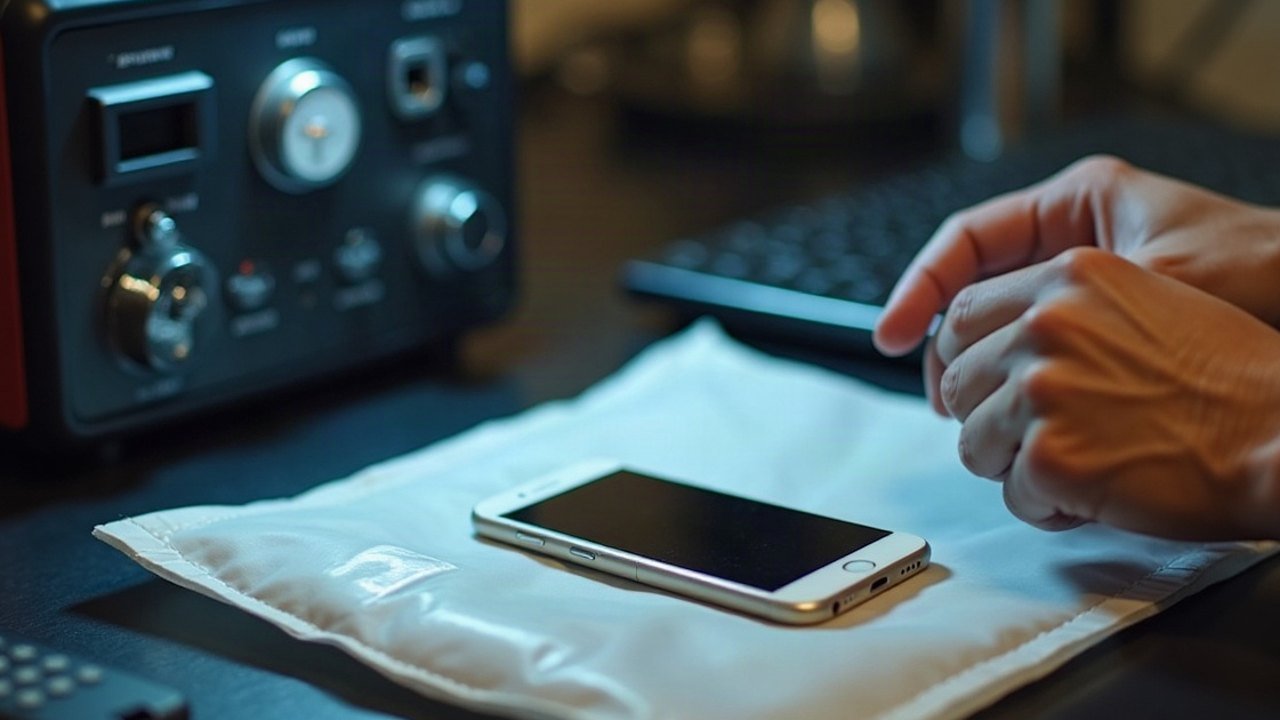
What the bag should block—and what it may not
| Signal or issue | What an effective bag could do | What it cannot establish |
|---|---|---|
| Cellular voice and data | Reduce connections to mobile networks | Whether stored location data will be uploaded later |
| Wi-Fi | Prevent or disrupt connection to nearby access points | Whether the phone or apps are free from malicious software |
| Bluetooth | Reduce links to nearby devices and trackers | That every Bluetooth frequency and device type has been tested |
| NFC/RFID | Reduce near-field radio communication under suitable conditions | That every payment or access scenario is secured |
| GNSS/GPS satellite reception | Reduce incoming satellite signals, possibly preventing fresh location fixes | Whether the phone already knows or stores a prior position |
| Malware or hacked accounts | Interrupt network traffic while effective isolation is maintained | Deletion of malware, stolen credentials or earlier compromised data |
| EMP or other extreme electromagnetic events | Potential reduction of some fields in tested circumstances | Survival of a particular phone in a real-world high-energy event |
These are capabilities that must be validated against the actual pouch. A seller's claim to block “all radiation” is not a useful technical specification.
Shielding effectiveness is measured in decibels
Laboratories may describe attenuation using decibels (dB) at specified frequencies. For power ratios, a 20dB reduction corresponds to a hundredfold reduction in received signal power, and 40dB to a ten-thousandfold reduction. Those figures are mathematical relationships, not claims about a particular product.
Shielding results vary by frequency and the test method. A sample of fabric performing well at 2.4GHz says little about a finished pouch with a poorly folded closure at a lower mobile frequency. Look for a report covering the exact product or at least the finished enclosure, its closure and the relevant bands—not just a certificate for a flat sheet of metallic fabric.
A useful example of this distinction appears in published laboratory-material test summaries, which explicitly distinguish tests of flat material from the behaviour of an assembled bag. Vendor-hosted reports should be read critically and are not independent endorsements of the entire product range.
Why seams and closures are often the weak point
A pouch is an enclosure with openings. If a seam tears, a zipper does not make the intended electrical contact, or the flap is not folded correctly, signals may leak through. The shielding fabric could be excellent while the assembled product is inconsistent.
Inspect the whole bag: look for holes, cuts, worn fold lines, delamination, loose seams and damaged closing surfaces. Compare the intended device size with the bag's usable internal dimensions. A phone forced against a closure can create an opening; a pouch crumpled around cables may not close as designed.
Do not pass a charging cable out of a bag unless the product specifically supports that arrangement; it could create a radio or electrical path that invalidates a test. Follow the maker's instructions for folding or closing the enclosure.
A practical at-home test using two devices
A household test can detect obvious leakage but cannot measure professional shielding performance. Use a second phone or another legitimate communication source to check the enclosed device. Do not involve emergency services or use a real SOS function.
- Charge the test phone sufficiently and ensure its normal cellular connection works outside the bag.
- Disable Wi-Fi calling if you are specifically testing cellular calling, and record the ordinary connection state.
- Place the phone fully inside, close the bag exactly as instructed and allow time for connection state to settle.
- Call the phone from a second ordinary phone; record whether a call connects, rings, diverts or goes directly to voicemail.
- Repeat using a Wi-Fi test and a Bluetooth connection with a known nearby accessory where possible, without sending private information.
- Open the bag, confirm the phone reconnects normally, and repeat after moving the phone to another position in the pouch.
- Record the test date, phone model, network and which functions were checked. Reinspect after wear or damage.
A call that goes to voicemail does not prove complete isolation: the phone may be switched off, out of coverage or diverted for another reason. A call that unexpectedly rings inside the bag is stronger evidence that the isolation or test setup is not working as intended.
Why a single unanswered phone call is weak evidence
Mobile calls may fail because of signal conditions, network congestion or handset settings. A phone might also continue to show cached Wi-Fi bars or signal indicators briefly after isolation. Some apps display a last-known location, which can be mistaken for a live update.
To establish the shielding itself, compare repeated tests outside and inside the pouch, across several radio functions if practical. For a critical use case, seek a qualified laboratory test of attenuation at the relevant frequencies with the bag properly closed.
Schneier's summary of Matt Blaze's work describes simple near-field checks as a useful go/no-go screen, not a measurement of exact attenuation. That's the right attitude towards at-home testing.
Does a Faraday bag prevent phone tracking?
It can interrupt some live wireless communications when effective. That can make the device unreachable and prevent fresh satellite fixes or network-based data exchange during the period of isolation. It does not delete the phone's earlier location history, records held by mobile providers or data already transmitted by apps. A phone may record movement using local sensors and reconnect later.
Even with perfect radio blocking, privacy depends on the device, accounts and what happens once the bag is opened. If your aim is privacy rather than preserving a phone against a hypothetical electromagnetic event, review device permissions and secure settings as well. Our AI surveillance and location tracking guide explains some of those separate controls.
A bag may also block contact from people you actually want to reach. A phone inside an effective shield cannot reliably receive a critical call or send an emergency message.
Can a Faraday bag stop a phone being hacked?
No bag removes malware or repairs compromised accounts. Temporarily isolating wireless radios can reduce immediate network communication in some cases, which may be useful for a specific forensic or security procedure, but a compromised device remains compromised when connectivity returns.
For routine account protection, the UK's National Cyber Security Centre advises secure updates, strong account authentication and appropriate backups. A pouch does not replace those controls. For responding to possible account compromise, see our account takeover and data-breach guide.
Where a device might contain important evidence, do not improvise actions that destroy data. Seek suitable professional advice for the specific situation.
EMP protection is a separate and much harder claim
An electromagnetic pulse is not one ordinary Wi-Fi signal. Its frequency content, electric and magnetic fields, intensity, duration, orientation and coupling paths can differ greatly. Laboratory attenuation of a phone pouch across selected RF bands does not automatically establish that a device will survive a particular nuclear or non-nuclear EMP exposure.
Tests described by the US defence environmental programme evaluate various signal-blocking products, but a procurement demonstration or a material test should not be read as a universal guarantee that every finished bag protects every device from every pulse.
Claims such as “EMP-proof”, “solar-flare proof” or “military grade” need a precise test method, frequency and field conditions, pass criteria and finished-product identification. Without them, the words tell you little about the result you should expect.
What changes if the phone is an emergency tool?
A pouch deliberately prevents incoming and outgoing wireless connections if it works. That can be the opposite of what you need if waiting for a rescue call, location update or alert. In many everyday situations the safer choice is to keep a communication device available and use normal security controls, not isolate it.
If you intend to keep a spare device shielded as one component of a wider backup plan, assess power and connectivity after removal. A bag does not recharge the battery or ensure an old phone will work when the network returns.
The offline communication ladder distinguishes devices used to receive alerts from devices intended for private contact.
Buying checklist: evidence before marketing
| Claim on a listing | Evidence to request |
|---|---|
| “Blocks every signal” | Measured attenuation versus frequency, with named methods and a finished-bag test |
| “100dB shielding” | The exact frequency range, test configuration, minimum recorded value and closure condition |
| “EMP-proof” | Relevant pulse-related test conditions and pass criteria for the actual enclosure and device |
| “Protects against hacking” | Specific threat model; physical RF isolation is not malware removal |
| “Privacy protection” | What transmissions are actually isolated, and what data remains stored or previously shared |
Inspect independent reports where available, then perform a harmless functional test with the actual phone and networks you plan to use. Don't treat a product's high price or tactical-looking fabric as technical proof.
Frequently asked questions
Will a phone ring inside a Faraday bag?
It should not receive a new cellular call if the bag effectively attenuates that link under the test conditions. But voicemail or a failed call can have other causes, so use several properly controlled checks.
Does a Faraday bag make a phone untrackable?
No. It may interrupt live radio connections while sealed, but cannot erase earlier records or guarantee what the device or apps do after reconnection.
Can a Faraday bag remove a virus or stop all hacking?
No. Signal isolation does not remove malicious software, reset passwords or repair compromised accounts.
Does blocking Wi-Fi prove EMP protection?
No. Wi-Fi isolation tests one radio scenario. EMP survival depends on different and much more demanding conditions and should not be inferred from one successful phone-call test.
Research and further reading
- Bruce Schneier — Matt Blaze's comparative Faraday enclosure tests.
- Lennox-Steele and Nisbet — forensic testing of commercial and improvised shielding, 2016.
- Published RF test summaries — distinguishing material from finished-bag measurements.
- US defence environmental programme — shielding product evaluation context.