A CUPBOARD OF FOOD ONLY HELPS IF THE FOOD REMAINS SAFE, USABLE AND EASY TO FIND.
A tin at the back of a cupboard is four years old. Another has a deep dent along the seam. A large bag of rice smells musty after spending summer in a damp garage. Which food is still usable, and which should you discard without tasting it? The answer depends on packaging integrity, product type, storage conditions and the difference between a best-before date and a genuine safety warning.
This is a long-term food storage guide for an ordinary home, with a practical rotation method, moisture and pest checks, container recommendations and safe inspection rules.
The UK Food Standards Agency's home food fact checker distinguishes damaged cans, opened food and best-before dates. The USDA's shelf-stable storage guidance explains how temperature, damp, corrosion and container integrity affect commercial canned foods. Neither source supports the claim that a packaged food lasts indefinitely merely because it is called “survival food”.
Food storage has three independent jobs
A good system must protect safety, maintain reasonable quality, and help people actually use and replace the stock. These jobs are related but not identical. A safe sealed tin might lose flavour or texture after a long period. An otherwise in-date can may be unsafe if its seam has failed. A nutritious package does little good if it is buried where nobody knows it exists.
For most households, the simplest approach is to hold familiar food in an appropriate cupboard, put older suitable stock at the front, use it in normal meals and replace items gradually. You do not need specialist software. For a separate shopping strategy that avoids waste, see our budget-first food reserve guide.
Long-term food storage is not the same as preparing food that is safe without power. Many dried foods still require cooking and safe water; see our no-cook emergency food list.
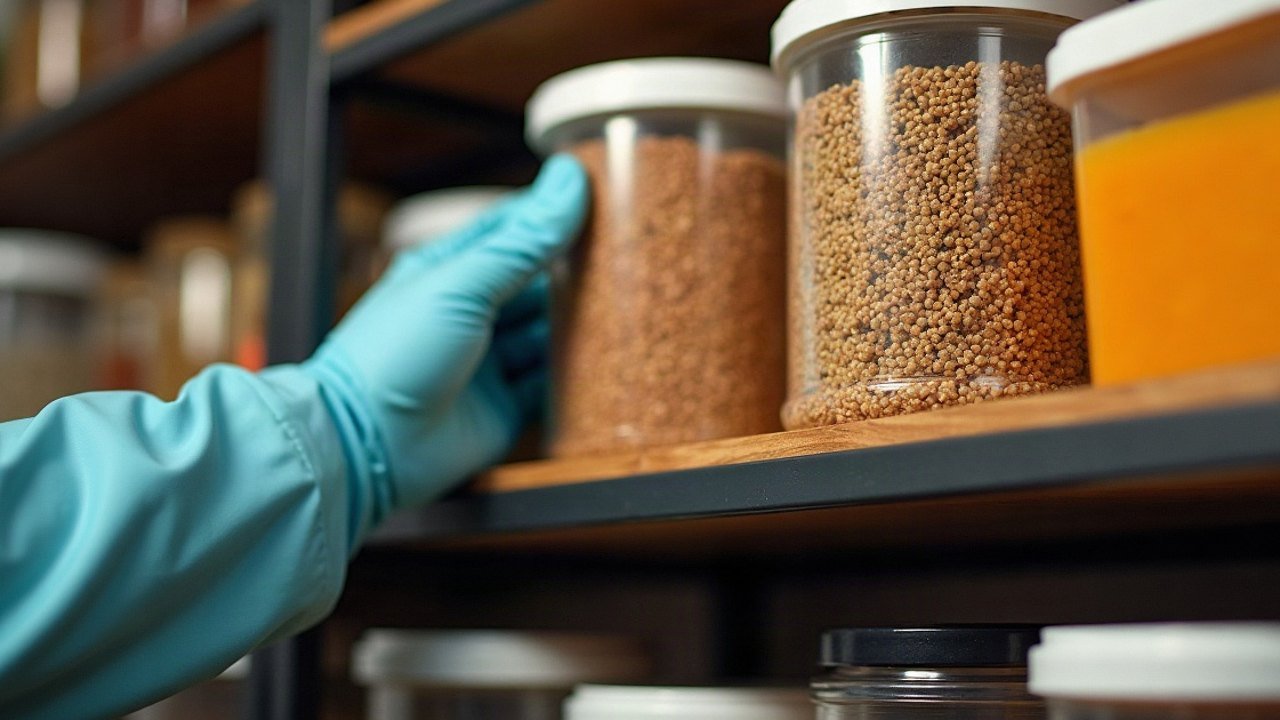
Cool, dry, dark and accessible: the right storage location
A good food cupboard is clean, dry and away from direct sunlight and repeated extremes of heat or cold. Heat speeds quality deterioration and can affect packaging. Damp encourages mould, corrosion and pest activity. Storing food close to household cleaners, fuel, pesticides, petrol or paint can create contamination concerns.
The US FoodSafety.gov emergency storage guidance describes a cool, dry, dark place, ideally around 4–21°C, while noting that real conditions differ. The USDA discourages shelves above a stove, damp garages, basements exposed to flooding and areas with temperature extremes.
You may not be able to maintain a particular temperature in every British home. Instead, identify the coolest consistently dry, safe and accessible space you have, monitor for damp and avoid locations obviously hostile to food quality.
Storage conditions by food type
| Food category | Useful storage method | Common failure |
|---|---|---|
| Commercial tins | Stable shelves in a cool dry cupboard, protect from damage | Rust, leakage, swelling or damaged seams |
| Dried rice, pasta and cereals | Follow packaging; protect from moisture and pests | Holes in packets, mould, insects, humidity |
| Flour and powdered foods | Clean dry storage, sealed food-contact containers where suitable | Moisture, stale flavour, pest infestation |
| Nuts, oils and seed products | Follow label, protect from excessive heat and light | Oxidation and rancidity |
| Ambient-stable drinks | Unopened as directed; inspect seal | Leaking packaging; refrigeration needed after opening |
| Specialist emergency meals | Exact manufacturer's conditions | Assuming advertised shelf life applies in heat or damp |
The instruction on the actual package takes precedence over a generic chart. Some products require refrigeration even before opening, some only after opening, and others may have special storage conditions because of their ingredients or packaging.
Use-by versus best-before: a critical distinction
Use-by relates to safety and is not optional. Perishable food should not be eaten beyond its use-by date even if it looks or smells normal. Best-before usually relates to quality, and appropriately stored unopened food may remain suitable after it, depending on the specific product and condition. The two labels should never be treated as interchangeable.
The Food Standards Agency's explanation makes this distinction explicit. It also warns that pathogens responsible for food poisoning may not be detectable by smell or sight. Do not use a “sniff test” to override a use-by date.
For best-before foods, inspect packaging, storage history and instructions. A package with water damage or broken seals is a different case from an intact packet merely past its best-before date. When there is uncertainty about safety, discard the product rather than taste-testing it.
How long do canned foods really last?
There is no single safe number for every can. The USDA says that commercially canned high-acid foods, such as tomatoes and certain fruits, often retain their best quality for roughly 12–18 months, while many low-acid canned foods may retain quality for about 2–5 years in suitable conditions. Those are quality-oriented ranges, not automatic expiry dates or a guarantee of microbiological safety for any individual can.
Packaging, processing, temperature and contents matter. High-acid products may affect the lining over time; hot storage accelerates deterioration. Follow the manufacturer's stated dates, storage requirements and instructions rather than treating a category estimate as a licence to ignore a damaged container.
Home-canned food requires distinct, rigorously validated processing and storage guidance. This article does not provide home-canning recipes or claim that ordinary boiling makes low-acid home-canned food safe.
Never taste food from a suspicious tin
Some forms of container damage are safety warnings rather than cosmetic flaws. A visibly bulging tin, leak, puncture, severely damaged seam, heavy rust or spurting contents may indicate loss of integrity or microbial activity. Discard such foods safely; do not taste them or offer them to animals.
The USDA warns that contaminated canned foods can present severe hazards including botulism. The UK home food fact checker similarly advises against consuming bulging, spurting or deeply damaged cans. A small superficial dent away from the seams may differ from a deep dent, but uncertainty about sealing should not be resolved by tasting.
When inspecting tins, look at the side seam and top/bottom rims as well as the body. Do not buy damaged containers because the price reduction looks attractive.
Moisture: the hidden problem in cupboards and garages
A dry pantry might still experience condensation near an external wall. An unheated garage may become damp in winter and warm in summer. Cardboard packaging and paper bags can absorb moisture, potentially affecting the contents. Mould, clumping, musty odours and wet packaging are warnings that a product may not have been stored properly.
Move food away from damp walls, check shelves for water staining and investigate leaks rather than simply placing more packages in front of the problem. If a food has become mouldy or wet and its safety is uncertain, discard it. Cutting away visible mould does not reliably make every food safe.
Use appropriate food-contact containers when transferring suitable dry goods, and keep the original label information so you know the product, ingredients, allergens and date. Don't pour new flour or rice on top of an old unknown batch and lose its history.
Food-safe containers and when repackaging is a bad idea
A clean, dry, food-grade airtight container may help protect certain dry foods from pests and moisture. But repackaging can introduce contamination if the container previously held chemicals, is damp inside or cannot be cleaned effectively. The new container should be suitable for food contact, labelled and easy to inspect.
Some products are better left in their original sealed packaging. Factory-sealed tins, pouches and drinks have specific barrier properties; repacking them into household tubs generally offers no improvement. Do not treat vacuum sealing or oxygen absorbers as a universal preservation technique.
Oxygen absorbers, moisture controls and desiccants must be used only with suitable food-safe systems and specific instructions. Incorrect combinations can introduce risks, especially when people attempt low-acid food preservation without validated methods. For ordinary household planning, manufacturer-packaged shelf-stable food is usually much simpler.
Check pests without creating a chemical problem
Insects and rodents can contaminate stored foods and damage packaging. Look for holes, droppings, gnaw marks, webbing or unusual debris during cupboard inspections. Clean the storage area, remove affected food and address how pests are entering rather than merely putting damaged items in another box.
Avoid spraying unsafe chemicals directly onto food or into unprotected food-contact containers. Use appropriately qualified pest-control assistance where needed and follow product directions. Keep cleaning chemicals, pesticides and food strictly separated.
Store food off floors exposed to flooding or leaks when practicable, and avoid blocking access to electrical controls or exits with boxes.
The simplest rotation rule: first suitable in, first out
Place older suitable products at the front and newly purchased replacements at the back. When cooking a normal meal, take the oldest appropriate intact product that remains safe to use. This is often called first in, first out (FIFO), though package dates and condition should take precedence over strict purchase order.
For example, if you have three sealed tins of chickpeas dated for different times, place the one with the nearest appropriate best-before date first. When you eat it, add its replacement at the back. Do not automatically use a damaged item just because it is older.
The Food Standards Australia New Zealand's canned-food advice recommends using older stock first and checking packaging condition. That principle applies to ordinary home cupboards without any elaborate equipment.
Make a label system people can actually use
A small label on each shelf or box can identify food category and nearest inspection date. If food has been transferred into a suitable container, record the food name, ingredients or allergen reference, original date, and when it was opened. Keep the original packaging details accessible when needed.
A simple table can help:
| Item | Quantity | Label date | Storage / action |
|---|---|---|---|
| Chickpeas, unopened tin | 4 | Refer to package | Rotate through ordinary meals |
| Rice, unopened dry bag | 1 | Refer to package | Check cool/dry storage and cooking dependency |
| Ready-to-eat crackers | 2 packs | Refer to package | Inspect seal and after-opening instructions |
| Ambient-stable drink | 3 small cartons | Refer to package | Use entire carton promptly if refrigeration unavailable |
The dates are deliberately not invented. Record the actual label and observed condition. A list is only useful if it matches what is on the shelves.
Why emergency food should be rotated through normal eating
Food that is never used creates two problems: nobody knows whether they like it, and it may deteriorate without being noticed. If you use the same beans, cereal, crackers and canned vegetables in everyday meals, the cupboard can renew itself naturally. That also spreads costs and keeps emergency options familiar.
The British Red Cross's budget guidance recommends beginning with what you own and adding affordable useful items over time. Rotation supports that approach: the reserve is part of ordinary household food, not a separate costly collection.
If a specialist food cannot be incorporated into normal life, check it more carefully for date, packaging and readiness. The advertised shelf life may be conditional on temperatures that your storage location does not maintain.
Opening a package changes the rules
An unopened ambient-stable carton or tin may be safe at room temperature according to its label. Once opened, oxygen, utensils, hands and environmental microbes can enter. Many products then require refrigeration and prompt use. The Food Standards Agency advises transferring leftovers from conventional open tins to a suitable container and refrigerating them.
In an outage with no functioning fridge, a bulk pack that would normally provide several servings may become impractical. Choose appropriately sized units and prepare only what can safely be consumed. Never assume that dry appearance makes cooked leftovers or opened wet foods safe indefinitely.
For a no-power meal planning approach that accounts for this, see our 72-hour ready-to-eat food guide.
How often to inspect a household food reserve
A quick monthly glance for damage, damp and pests can catch obvious problems. A more deliberate review every few months can update dates and quantities. The exact schedule depends on your products and storage environment; there is no need to discard sound food just because a calendar reminder appears.
During an inspection, check the environment first, then packaging, then dates and inventory. A cupboard repeatedly developing condensation needs fixing before it is refilled. Rotate suitable products into normal meals, remove unsafe containers without tasting, and replace only what is useful.
Use an accessible checklist rather than relying on somebody remembering where the oldest tin is. If multiple adults share the cupboard, a clear shelf order and simple list prevent confusion.
A 20-minute pantry inspection
- Check the cupboard for leaks, condensation, heat, sunlight and nearby cleaning chemicals.
- Look for insects, rodent evidence, torn packets or damaged shelves.
- Inspect tins for swelling, leakage, rust and damage to seams.
- Read use-by and best-before information according to the actual product.
- Check that transferred dry foods remain clean, dry and clearly labelled.
- Move older safe stock to the front and newer items behind.
- Remove unsuitable products without tasting them.
- Update your shopping list with only the practical gaps.
Keep the process simple and repeatable. A smaller reserve inspected regularly may be more useful than a large, neglected cupboard.
How to compare long-life claims without being misled
If a packet advertises a 10-, 20- or 25-year shelf life, ask under what conditions that claim was established. What temperature range, moisture exposure, packaging and product formulation were tested? Is the claim about food safety, nutritional value, taste or another quality? What preparation equipment and water does the food require?
Do not infer that all foods in an emergency bundle share one lifetime. Oil-rich nuts, crackers, dried vegetables and freeze-dried products can degrade differently. An expensive label does not prove that the packaging will stay intact in a damp British garage.
Choose products around actual household needs and your ability to maintain their required conditions. If you cannot verify the claims, do not rely on them for a critical plan.
Three real-life storage scenarios
Scenario A: a cool kitchen cupboard with intact tins. The owner can inspect dates and damage, use older stock in normal meals and replace it gradually. The arrangement is relatively simple.
Scenario B: a garage that develops condensation. Dry bags become damp and tin seams begin to rust. Moving food to a consistently dry indoor area is more important than buying additional sealed containers and ignoring the moisture source.
Scenario C: a cupboard of specialist food nobody has opened. The products may require hot water and contain ingredients household members cannot eat. Trying the preparation instructions and reviewing allergens is more useful than adding more of the same.
The principle is not “store more”, but “know exactly what remains safe, usable and practical”.
Frequently asked questions
Do canned foods last forever?
No. Condition, contents, processing and storage affect quality and safety. Follow product instructions and reject leaking, bulging, rusted or badly damaged cans.
Is food safe after its best-before date?
Best-before normally relates to quality rather than a strict safety cutoff, but the decision depends on the food and how it was stored. Use-by dates are safety-related and should not be exceeded.
Can I store emergency food in a garage?
Only if the location reliably meets the product's conditions and is protected from damp, temperature extremes, chemicals and pests. Many garages are poor storage environments.
What's the easiest way to rotate emergency food?
Keep familiar unopened stock in accessible shelves, use older suitable packages in normal meals first, add replacements to the back and inspect the cupboard regularly.