A BATTERY IN THE HOUSE IS NOT THE SAME AS A WORKING BACKUP SYSTEM.
Your home has solar panels and a 10kWh battery. The street loses power. Will the battery continue supplying the fridge and lights—or shut down along with everything else? The answer depends on how the system was designed and installed. A battery that saves money by shifting electricity use between day and night is not necessarily wired to provide emergency power when the grid fails.
This article explains home battery backup during a power cut: the difference between stored energy and available power, how backup circuits work, the questions to ask an installer and how to estimate the devices you could keep running. If a household battery is something you are considering, the aim is to assess real capability before buying or relying on it—not to assume that having a battery makes the property independent of the electricity network.
Energy Saving Trust's battery storage guidance explains that home batteries can store energy from solar panels or lower-cost grid electricity for later use. Emergency backup capability is a separate design question and must be confirmed for the particular inverter, controls and wiring.
Why a home battery may shut off in a power cut
Grid-connected electrical systems are ordinarily designed to stop energising the public network during an outage, to protect people working on cables and to maintain electrical safety. A standard solar inverter does not simply continue feeding an isolated home when the grid goes down. Some hybrid inverters and storage systems can form a safe, separated local supply, but they need suitable equipment and correctly installed isolation and backup arrangements.
This function is often described using terms such as backup output, emergency power supply (EPS), islanding capability or whole-home backup. The terms are not interchangeable specifications: one system may power a dedicated socket; another may supply a limited set of circuits; a more substantial system may support much of a house. Each has constraints.
Energy Saving Trust's August 2026 solar guidance notes that typical rooftop panels cannot automatically power a property during a blackout unless the installation has additional equipment. Ask an installer to demonstrate the actual backup configuration, rather than treating a battery's presence as proof.
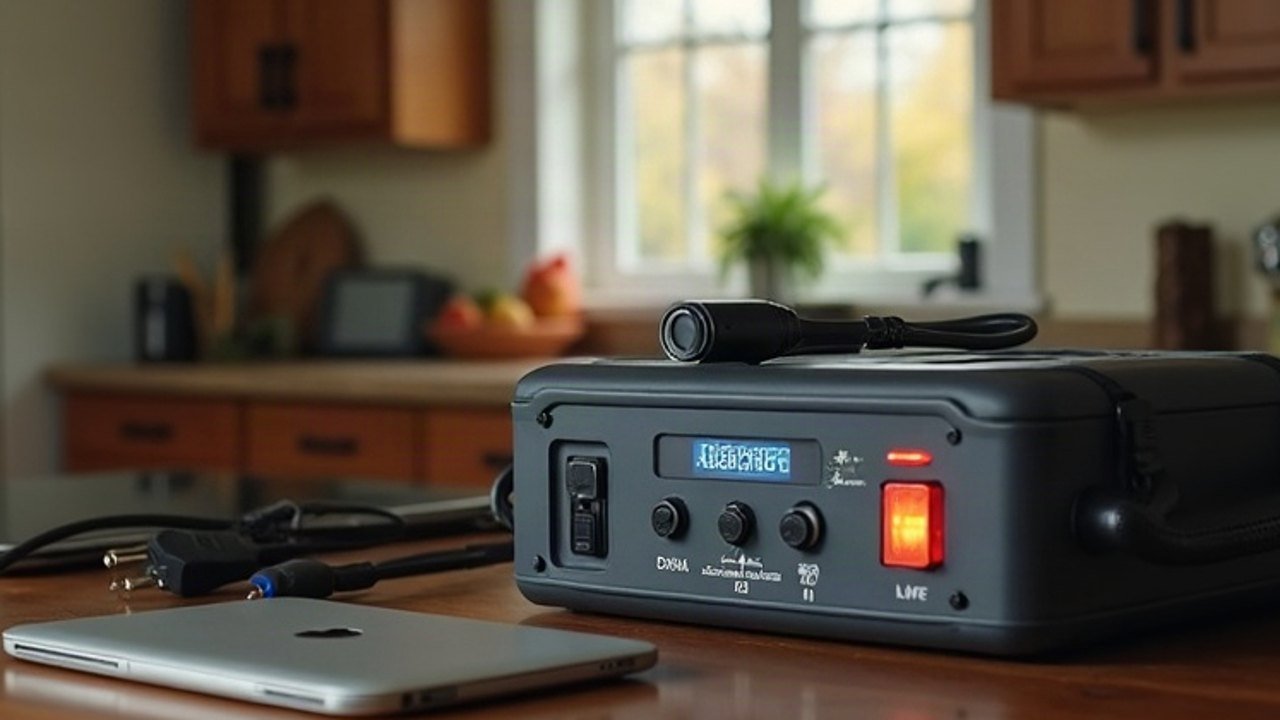
Three systems that can look similar but behave differently
| Installation | Normal purpose | During a grid outage |
|---|---|---|
| Ordinary grid-connected solar only | Use or export solar generation | Usually stops grid-connected supply for safety |
| Battery for self-consumption or time-of-use tariffs | Store electricity and reduce grid purchases | May shut down unless configured and equipped for islanded backup |
| Battery with designed EPS/backup circuits | Store energy and power specified loads during outage | Can supply approved backed-up circuits within rated limits and available energy |
| Portable battery/power station | Supply portable appliances through its own outlets | Can operate independently for compatible devices; not a substitute for an installed house backup |
The terms in the quotation or marketing page are less important than a written explanation of what will remain energised after the grid fails. An installer should identify the relevant circuit breakers and any automatic or manual changeover procedure. Ask whether the system has been tested with the grid safely isolated.
Capacity and output: the two numbers you cannot ignore
Capacity is the amount of stored energy, usually measured in kilowatt-hours (kWh). Output rating is how much power the inverter can supply at a time, measured in watts or kilowatts (kW). A 10kWh battery does not necessarily supply a 10kW appliance, and a 5kW inverter does not mean the battery lasts five hours.
For example, if a 10kWh battery had an illustrative 8kWh of usable energy available after reserve and losses, a constant 400W load (0.4kW) would consume that energy in about 20 hours: 8kWh ÷ 0.4kW. But a constant 2kW load would shorten the same energy budget to roughly four hours. Actual results depend on the reserve setting, state of charge, temperature, battery age, inverter losses and simultaneous loads.
The output rating also needs to accommodate motor and compressor startup surges. A load may consume little energy over a day but demand a short spike beyond what an inverter supports. Ask the installer to assess that separately rather than using average daily watt-hours alone.
What does '10kWh battery' actually mean in practice?
A label may describe nominal energy, while the system's usable energy can be lower because it protects the cells from excessive discharge and reserves power for controls. Energy Saving Trust describes systems stopping discharge at a configured reserve, sometimes around 20%, to protect battery operation. Do not automatically multiply all batteries by 80%—look for the particular product's usable-capacity specification and site settings.
A battery may also have an adjustable blackout reserve. If the system has discharged overnight to save on a tariff, there may be little stored energy left when a morning outage begins. Some installations allow the user to keep a minimum level for emergencies. Confirm how that works and whether it changes after software updates or tariff automation.
When reviewing a quotation, ask for rated capacity, usable capacity, maximum continuous output, peak output, inverter standby power, permitted backup circuits and the expected reserve. Each answers a different question.
Backed-up circuits matter more than marketing photographs
A backup system may power only a designated consumer-unit section: for example, lights, certain sockets and communications equipment. Ovens, electric showers, heat pumps or EV chargers may deliberately be excluded because they could exceed the inverter's output or empty the battery quickly.
Discuss actual priorities with a qualified installer. The most important circuits may be a boiler control, an internet device, basic lighting or an accessible lift controller—but their suitability for backup is a technical and, where relevant, clinical decision. Do not assume a gas boiler is self-sufficient just because it burns gas; many require electricity for pumps and controls.
| Potential backup load | What to measure | Why it matters |
|---|---|---|
| LED lighting circuit | Combined draw when the required lights are on | Usually modest energy, but multiple circuits may need wiring work |
| Broadband router and networking | Watts and any optical-network terminal load | Local backup helps only if the provider's network is also operating |
| Fridge/freezer | 24-hour energy and compressor startup surge | Average consumption and peak output are different constraints |
| Boiler controls | Electrical requirements and safe operating compatibility | Gas heating can still require stable electrical power |
| Induction hob or electric heating | High continuous wattage | Can dominate the entire energy budget rapidly |
| Medical equipment | Approved clinical power requirements | Requires specialist backup design and a separate care contingency |
It is often sensible to reduce simultaneous demand rather than aim to energise every socket. The household may prefer the ability to use a few essential circuits for longer instead of running power-hungry equipment for a short period.
Worked scenario: one evening on a home battery
Suppose an installed backup system has 6,000Wh available for selected appliances at the start of an outage. Over the next 12 hours, you use lighting averaging 30W, communications devices averaging 20W, a fridge averaging 35W and occasional laptop use totalling 180Wh. The arithmetic is:
| Load | Calculation | Energy used |
|---|---|---|
| Lighting | 30W × 6 hours | 180Wh |
| Router and network equipment | 20W × 12 hours | 240Wh |
| Fridge, average measured over 12 hours | 35W × 12 hours | 420Wh |
| Laptop | Measured or estimated total | 180Wh |
| Combined use | — | 1,020Wh |
That would consume 1.02kWh of the assumed 6kWh energy budget, leaving 4.98kWh before any extra losses or loads omitted from the calculation. This is an illustrative energy budget, not a claim that a particular system can operate for days; inverter standby consumption, changing refrigerator demand and state-of-charge reporting can affect reality.
For a comparable calculation involving a portable battery and folding panel, see our portable solar generator runtime guide. That article also explains why a compressor's startup surge must be checked separately from its average energy use.
Can your rooftop panels recharge the battery during a blackout?
Some appropriately designed backup systems permit solar generation to charge the battery while islanded from the public grid. Others do not, or have limits on solar input when running as backup. The arrangement depends on how panels, inverter, battery and electrical protection interact.
Even when supported, solar generation changes with sunlight. Energy Saving Trust confirms that panels can produce electricity in cloudy weather but are less productive in winter. Do not assume a home battery can automatically recharge to full each day, especially during several short, dull days.
Ask the installer to document whether solar charging works in island mode, what happens when the battery reaches its limits, whether a backup generator can be integrated (if relevant), and how the system safely returns to normal grid connection. These functions need engineered controls, not improvised wiring.
Battery versus UPS: which job are you trying to solve?
A UPS (uninterruptible power supply) is typically designed to keep a specific load such as a computer or networking appliance operating through a brief interruption, often switching extremely quickly. A home battery with backup capability may support larger loads for longer but can have a switch-over interruption. Not all inverters provide the power quality or transition time required by sensitive electronics.
Ask for the system's documented transfer time and compatibility with any equipment that must not reboot. For ordinary internet connectivity, a purpose-made networking UPS may be simpler than a large whole-home installation. For healthcare equipment, consult its supplier and care team, not a general website comparison.
Do not plug a generic UPS into a fixed household circuit or attempt to create a house-wide backup using extension leads. Appropriate electrical protections, load limits and professionally installed isolation are essential.
What should be in the installer quotation?
- Backup scope: a written schedule of exactly which circuits or outlets are powered in an outage.
- Rated and usable storage: battery energy, reserve settings and performance assumptions.
- Power limits: continuous output, surge capability and any loads explicitly excluded.
- Grid separation: how the installation prevents unsafe export to a de-energised public network.
- Changeover: automatic or manual action required, and documented transfer interruption.
- Solar charging: whether panels continue charging during an outage and under what limits.
- Monitoring: how to check stored energy without relying on an unavailable internet service.
- Maintenance and warranties: support, installation documentation, expected battery life and replacement arrangements.
- Test procedure: commissioning evidence showing selected loads worked safely during a controlled mains-disconnection test.
Energy Saving Trust recommends comparing qualified installers and considering the battery with the household's overall energy use. The cheapest-looking quotation may exclude the separate hardware and wiring needed for usable blackout backup. Request a clear written scope so quotes are comparable.
Why installation and electrical safety are non-negotiable
A battery capable of supplying mains power is electrical equipment with significant stored energy. Fixed home backup requires correct protection, isolation, cable sizing, ventilation where specified and compliance with applicable electrical rules. Never try to backfeed a home through a socket or bypass protective equipment. Such arrangements can harm occupants and utility workers.
Electrical Safety First explains the risks of overloaded extensions, damaged cables and daisy-chained leads. Those risks increase when a large backup supply is distributed through improvised adaptors. Leave wiring to competent, appropriately qualified professionals.
Read the manufacturer restrictions on operating temperature, location and battery ventilation. Do not cover equipment or store flammable items against it. If a device reports an internal fault, follow the manufacturer and installer's safe procedure rather than opening the enclosure.
What if you do not own the home?
Renters and flat residents may not be able to install a permanent battery without property-owner, building-management or other approvals. Shared electrical systems and fire-safety requirements can be more complex than those of a detached house. A standalone battery powering a few portable appliances may be an alternative if permitted and safely used, but it does not supply communal lifts, building pumps or shared alarms.
Before buying anything, identify what depends on building-wide power and who manages it. A written fallback for essential communication and a suitable alternative location may be more practical than a large storage device in a small rented property.
Don't mistake financial optimisation for emergency resilience
A battery bought to charge on cheap electricity and discharge at expensive tariff times may be economically useful, but that says nothing by itself about blackout performance. A system may routinely reach a low state of charge before a storm; a backup reserve could alter the economics; or the approved backup outlet may be positioned away from the devices you want to operate.
Ask two different questions: Will this installation reduce my normal electricity costs? and Which verified activities can it support when the public grid is down? One does not answer the other. For the wider household dependency context, read what happens when the power grid fails.
A safe acceptance test after installation
Ask the installer to demonstrate the system's authorised blackout mode as part of commissioning. The test should be controlled by qualified personnel and should confirm which circuits are live, whether communications equipment stays operating, how the battery reports its state, and how normal supply is restored.
Then keep the relevant circuit list and operating instructions accessible without an online app. If no test has been completed, do not treat the feature as proven merely because a settings page includes the word 'backup'. Retest as advised after significant system changes.
Frequently asked questions
Will solar panels and a battery work during a power cut?
Only if the system is designed and installed with appropriate backup/islanding capability. Ordinary grid-connected solar and storage may shut down when the public network fails. Verify the specific backed-up circuits and operating procedure.
How long does a 10kWh home battery last?
It depends on usable energy, reserve and loads. In an illustrative case with 8kWh usable, a steady 400W load would have an energy-only runtime of about 20 hours before unmodelled losses or changes in demand.
Can I backfeed my house with a portable battery?
No. Connecting a portable power source to house wiring through a wall socket is unsafe. Fixed backup needs professionally installed protection and isolation.
Do I need a whole-home backup system?
Not necessarily. Selected essential circuits, a small UPS, a portable power station or a non-electrical fallback may better match the actual outcome you need. Confirm the purpose before choosing equipment.